
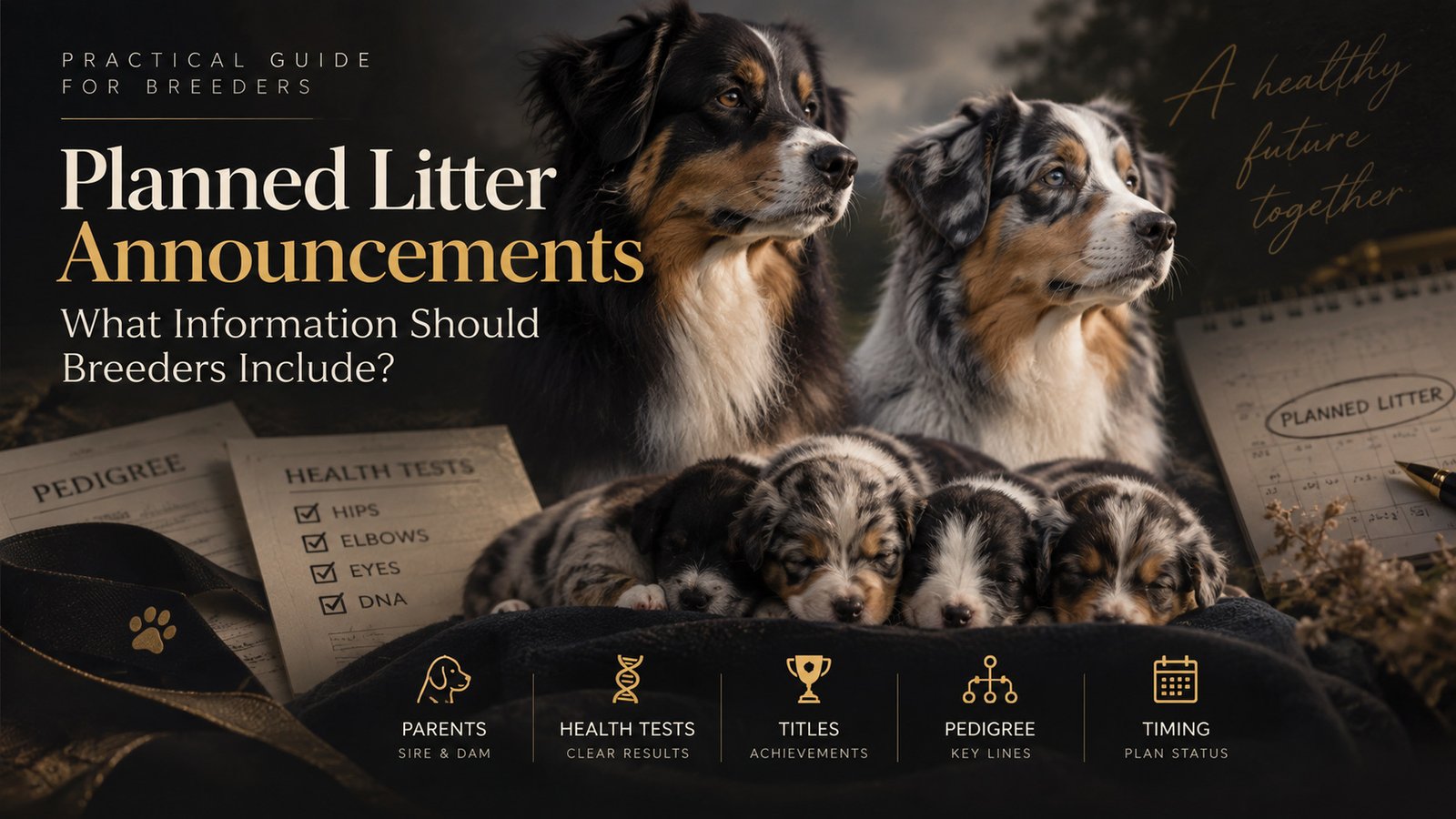
A planned litter announcement is not simply an attractive advert. It is the first structured piece of communication many people will see about a breeding decision. It should identify the proposed parents, present relevant evidence accurately and make the stage of the plan unmistakable.
The strongest announcements are selective. They give serious prospective owners enough information to understand the combination and contact the breeder, while directing them to fuller health, pedigree and kennel records elsewhere.
Start with the Parents
The sire and dam should be identifiable without guesswork. Use their complete registered names as recorded by the relevant registry. If call names are widely used or help readers recognise the dogs, add them in quotation marks or a smaller secondary line.
Label the dogs clearly as sire and dam. Do not rely on left–right placement or assume every viewer knows which dog is which. Kennel prefixes and suffixes form part of the registered name and can help experienced breeders recognise lines, but they should be copied from official records rather than reconstructed from memory.
Good photographs also support identification and credibility. Use current, representative images with the owner or photographer’s permission. Avoid heavy editing that changes colour, structure or other features relevant to how the dog is perceived.
Pedigree Information
A planned litter graphic rarely needs a complete multi-generation pedigree. Full pedigrees are difficult to read on a social-media image, especially on a phone. Instead, decide what helps the audience understand the combination.
Useful options include the parents’ registered names, a short reference to notable lines, or a link to a reliable pedigree database or kennel page. If a particular ancestor is important to the breeding rationale, explain that in the accompanying text rather than squeezing several generations into the design.
Pedigree information should be accurate and traceable. Repeated ancestors, coefficients of inbreeding and line descriptions need enough context to be meaningful; isolated claims such as “exclusive bloodline” or “world-famous pedigree” communicate little without evidence.
Health and Genetic Test Information
Health information is one of the most valuable parts of a breeder announcement, but it must be precise. Prioritise the tests and schemes relevant to the breed and the proposed combination. Name the result, not just the fact that a dog was “health tested”.
Short, standardised lines work well when the audience understands the terminology—for example, official hip or elbow scores, the date or current status of an eye examination, and specific DNA results. If abbreviations differ between countries or could be misunderstood, write them out or explain them in the caption.
Do not write “genetically healthy”, “disease-free” or “guaranteed healthy puppies” on the basis of a panel. DNA tests cover named variants; clinical screening answers different questions; and no programme eliminates every hereditary or environmental risk. A more credible statement identifies exactly what was tested and offers access to the original certificates or database records.
If the two parents have different results for a recessive variant, make sure the wording reflects the expected litter correctly. “Clear by parentage” should only be used when the registry or health programme’s requirements are satisfied.
Titles, Working Results and Achievements
Titles and working results can show that the parents have been assessed in relevant disciplines, but a dense block of abbreviations is not automatically impressive. Select the achievements most closely connected to the breed’s purpose, the breeding aim and the intended audience.
Use the official form of each title and check whether it belongs before or after the registered name. Systems differ across countries and kennel clubs; the same abbreviation can have different meanings. When an international audience is likely, spell out the most important result in the accompanying text.
A useful hierarchy might show one or two major championships, a significant working qualification, and a relevant temperament or breed-specific assessment. Remaining results can sit on the kennel website. The announcement should communicate distinction, not reproduce the dog’s entire record.
Planned Timing
Timing language should match what is known. “Planned for winter 2027” means something different from “mating completed”, “pregnancy confirmed” or “puppies expected in March”. Keep the wording current as the breeding progresses.
Before mating, avoid exact birth dates and guaranteed litter claims. Reproductive timing, conception and pregnancy outcome cannot be promised. After veterinary confirmation, an expected period can be stated, while still recognising that whelping dates vary.
If enquiries or applications are open, say so clearly. “Expressions of interest welcome” may be more accurate at the planning stage than “puppies available”. Also state whether there is a waiting-list process, an application form or a preferred contact route.
Kennel and Contact Information
Prospective owners need enough information to identify the breeder and take the next step. Include the kennel name, country or broad location, website and one reliable contact method. A social-media username may be useful, but it should not replace a stable website or email address if those are available.
Where appropriate, include the recognised registry or kennel-club affiliation. Do not imply that registration alone certifies health, ethics or quality; it records identity and ancestry under that organisation’s rules.
A dedicated litter page can carry fuller information: copies or links to health results, pedigree, biographies of both parents, breeding aims, application process and updates. The announcement then acts as a clear entry point rather than trying to contain everything.
Use the Caption to Add Context
The graphic and its caption have different jobs. The image should remain understandable at a glance; the caption can explain why the combination was chosen, what stage has been reached, where results can be verified and how enquiries are handled. This is also the right place to translate uncommon abbreviations or clarify differences between international titles.
Date the announcement or update the original post as circumstances change. If a mating does not proceed, pregnancy is not confirmed or plans change, say so. Accurate updates protect trust and prevent an old image from circulating as if it described the current situation.
What Should Be Left Out?
- Excessive text: long paragraphs become unreadable when the image is viewed on a phone.
- Unexplained abbreviations: they can hide rather than demonstrate achievement.
- Unsupported superlatives: “best”, “perfect”, “elite” and “exceptional genetics” need evidence and often reduce credibility.
- Misleading health claims: testing reduces uncertainty but does not guarantee healthy puppies.
- Premature availability claims: a planned mating is not a confirmed pregnancy or born litter.
- Private information: use professional contact details rather than unnecessary personal data.
- Visual clutter: too many logos, flags, frames, fonts and decorative effects compete with the dogs and key facts.
Professional restraint is not a lack of information. It is a decision about what belongs on the graphic, what belongs in the caption and what belongs on the website.
Planned Litter vs Litter Born vs Puppies Available
These are three different communication stages and should not share identical messaging.
| Stage | Main purpose | Essential wording |
|---|---|---|
| Planned litter | Introduce the proposed combination | Planned timing, sire and dam, breeding intention, enquiry status |
| Litter born | Report an actual birth | Birth date, number and sex of puppies, welfare-focused update |
| Puppies available | Communicate genuine availability | Which puppies may be available, age or timing, location and application route |
Updating the message prevents confusion. A graphic that still says “planned litter” after puppies are born looks neglected; a pre-mating post that says “puppies available” creates an expectation the breeder cannot yet meet.
A Practical Planned Litter Announcement Checklist
- Exact registered names of sire and dam
- Clear sire/dam labels and optional call names
- Accurate, permission-cleared photographs
- Most relevant pedigree or line information
- Breed-relevant health and genetic results, stated precisely
- Selected major titles, working results or assessments
- Correct stage: planned, mated, pregnancy confirmed, born or available
- Realistic expected period rather than a guaranteed date
- Kennel name, country or region, website and contact route
- Readable mobile layout and consistent spelling
- A final check against certificates, registry records and the current breeding plan
If the information is sound but needs a clear visual hierarchy, a professional dog litter announcement design can organise the parents, health data and timing without turning the graphic into a certificate wall.
Final Takeaway
A planned litter announcement should be accurate before it is impressive. Identify the parents, select meaningful pedigree, health and achievement information, describe the stage honestly and give readers a professional route to further details. The result becomes useful breeder communication as well as attractive promotion.
Find more breeder-focused guidance on the BodArtDogs blog.