
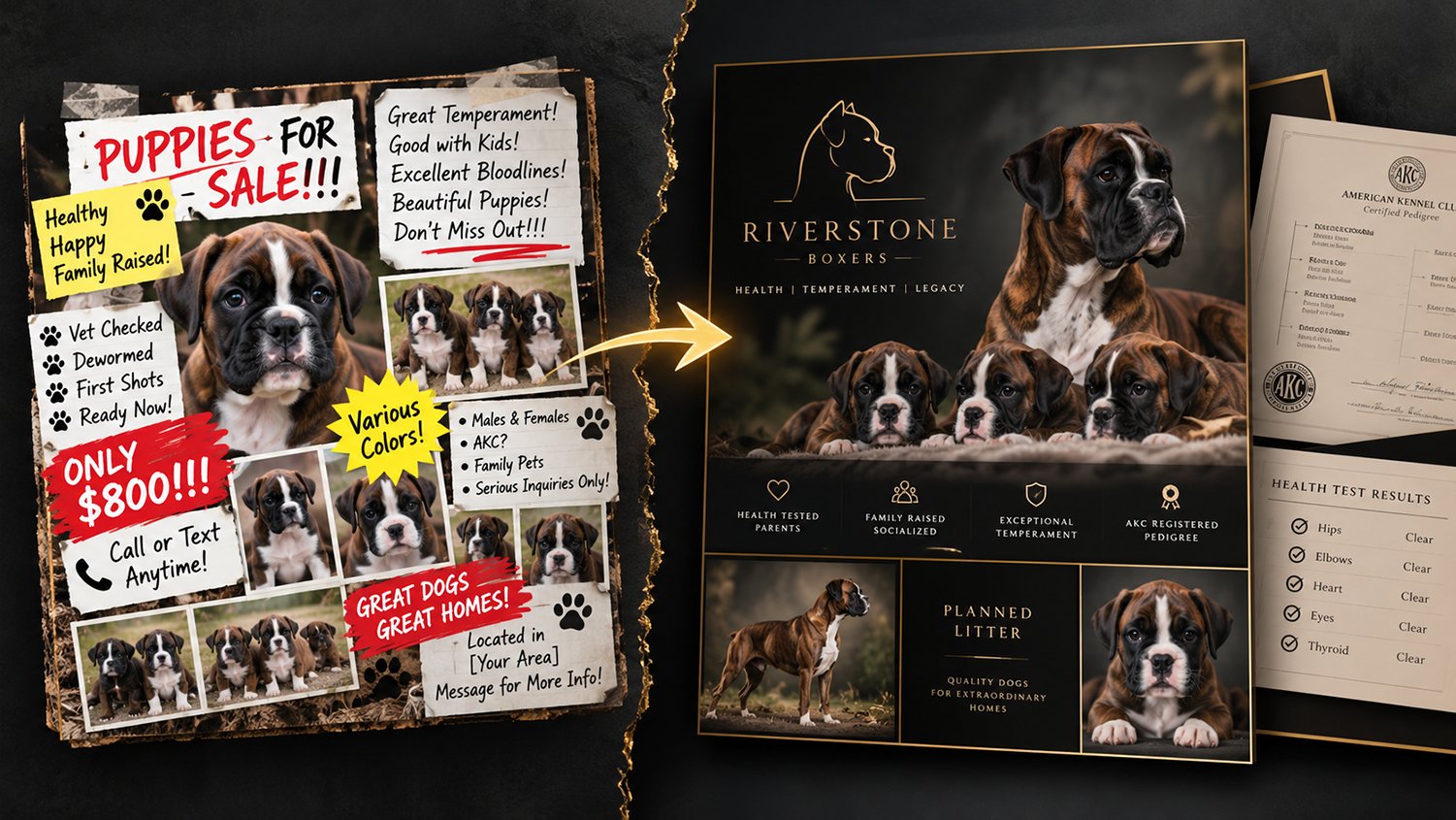
A dog breeder ad has only a few seconds to make its purpose clear. The reader should be able to understand what is being presented, recognise the kennel, find the essential facts and know where to learn more. When everything competes for attention, even valuable information can become difficult to trust or remember.
Before looking at common mistakes, it helps to separate four different formats. A breeder advertisement presents a kennel or breeding programme. A litter announcement communicates a particular pairing, pregnancy, birth or available litter. A stud dog advertisement introduces a male available for suitable breeding enquiries. A dog presentation graphic focuses on one individual dog’s qualities, results, health information or pedigree. Each needs a different hierarchy.
A litter announcement presents a planned or current litter as a whole, while a puppy advertisement focuses on one or more individual puppies currently available.
1. The purpose is not immediately clear
A graphic that tries to introduce the kennel, announce a litter, advertise a stud and celebrate a show result at the same time usually weakens every message. Decide on one primary action. Should the reader view the litter page, enquire about a puppy, review a stud dog’s information or simply remember the kennel?
Write that purpose in one sentence before designing. If the sentence contains several unrelated goals, create separate materials rather than one crowded advertisement.
2. Every available detail is placed on the graphic
Pedigrees, health results, titles, dates, colour information and contact details can all matter, but they do not all need equal visual weight. A social graphic should guide the reader towards the next source of information, not replace a complete website page.
Use a short information hierarchy: the main announcement, the dogs or litter involved, the most relevant supporting facts and one next step. Put fuller pedigrees, explanations and documents on the kennel website.
3. Essential information is missing
Reducing clutter should not mean removing the facts needed to understand the offer. For a litter announcement, readers may need the kennel name, breed, sire and dam, expected or birth timing and a clear link. A stud dog presentation may need the dog’s registered name, relevant titles, key health information and the route for a suitable enquiry.
The exact details depend on the purpose and the audience. Our guide to what to include in a planned litter announcement provides a practical checklist for pairing-specific communication.
4. The photograph is attractive but unsuitable
A favourite photograph is not always a strong advertising image. Cropped ears or paws, a busy background, low resolution, harsh light or a dog blending into the surroundings can make the design difficult to read. For a breeding pair, two photographs with completely different angles and lighting can also feel disconnected.
Choose clear, sharp images with enough space around the dog for flexible cropping. When possible, use similarly framed photographs for both parents in a litter announcement. Good source material gives both simple and highly finished designs more credibility.
5. Text becomes unreadable on a phone
Many breeder graphics are first seen as small images in a social feed. Thin type, long paragraphs, ornate scripts and low-contrast gold-on-light backgrounds may look acceptable on a large monitor but disappear on a phone.
Test the final design at the size in which it will actually appear. Keep the headline short, increase contrast and reserve decorative type for a few words. Details that cannot remain legible belong in the caption or on the linked page.
6. The kennel has no recognisable visual system
Changing colours, fonts and logo placement for every announcement can make an active kennel look like several unrelated breeders. Consistency does not require identical templates. It means keeping a recognisable foundation while adapting the layout to each message.
A small system of type, colours, logo rules and image treatments can support litter announcements, puppy cards, results and stud presentations without making every post look the same. This is where a broader set of custom graphics for dog breeders can be more useful than an isolated design.
7. Claims are shown without enough context
Words such as “health tested,” “champion lines” or “excellent pedigree” are too broad when they stand alone. If a health result or title is central to the message, state it accurately and make the detailed record easy to find. Avoid implying that one result guarantees an outcome for a future puppy.
Clear communication is particularly important around genetic results. The article Health Testing for Breeding Dogs explains why meaningful presentation includes the test, result and breeding context rather than a vague badge.
8. One template is forced onto every format
A litter announcement needs to balance two parents and litter timing. A stud dog ad needs to establish the individual male and support a breeding decision. A dog presentation may prioritise a portrait, show titles or pedigree, while a breeder advertisement may lead with the kennel’s programme and values.
Reusing brand elements is sensible; reusing the same information structure is not. Choose litter announcement design for a pairing-specific message, and a stud dog or dog presentation when the individual dog is the subject.
9. Platform crops are ignored
A design made for one landscape format may lose names, faces or contact details when a platform displays it as a square or vertical preview. Placing critical information close to the edges also increases the risk of accidental cropping.
Plan the main composition inside a safe central area and prepare intentional versions for the channels that matter. Do not simply stretch one file. Check the thumbnail, feed view and full-size image before posting.
10. There is no useful next step
“Contact us” is less helpful when the reader cannot tell where to go or what information to provide. Use one clear route: a litter page, stud page, enquiry form, public business email or kennel social profile. The link and account name should be easy to type or tap.
The call to action should also match the message. A litter post might invite readers to view the litter information. A stud presentation can direct suitable breeders to the dog’s full health and pedigree details. A kennel introduction can lead to an overview of the breeding programme.
A better breeder ad starts with structure
Professional design is not about making responsible breeding communication louder. It is about making the right information easier to understand. Define the format, choose one purpose, organise the evidence and then build a visual hierarchy around it.
When litter announcements, stud dog ads and individual dog presentations share a recognisable kennel identity but retain their own structure, they can work together as a clear, consistent record of the breeding programme.
Need a clearer, more professional way to present your litter, stud dog or breeding dog?
Send a project enquiry and tell me what you would like to create.