
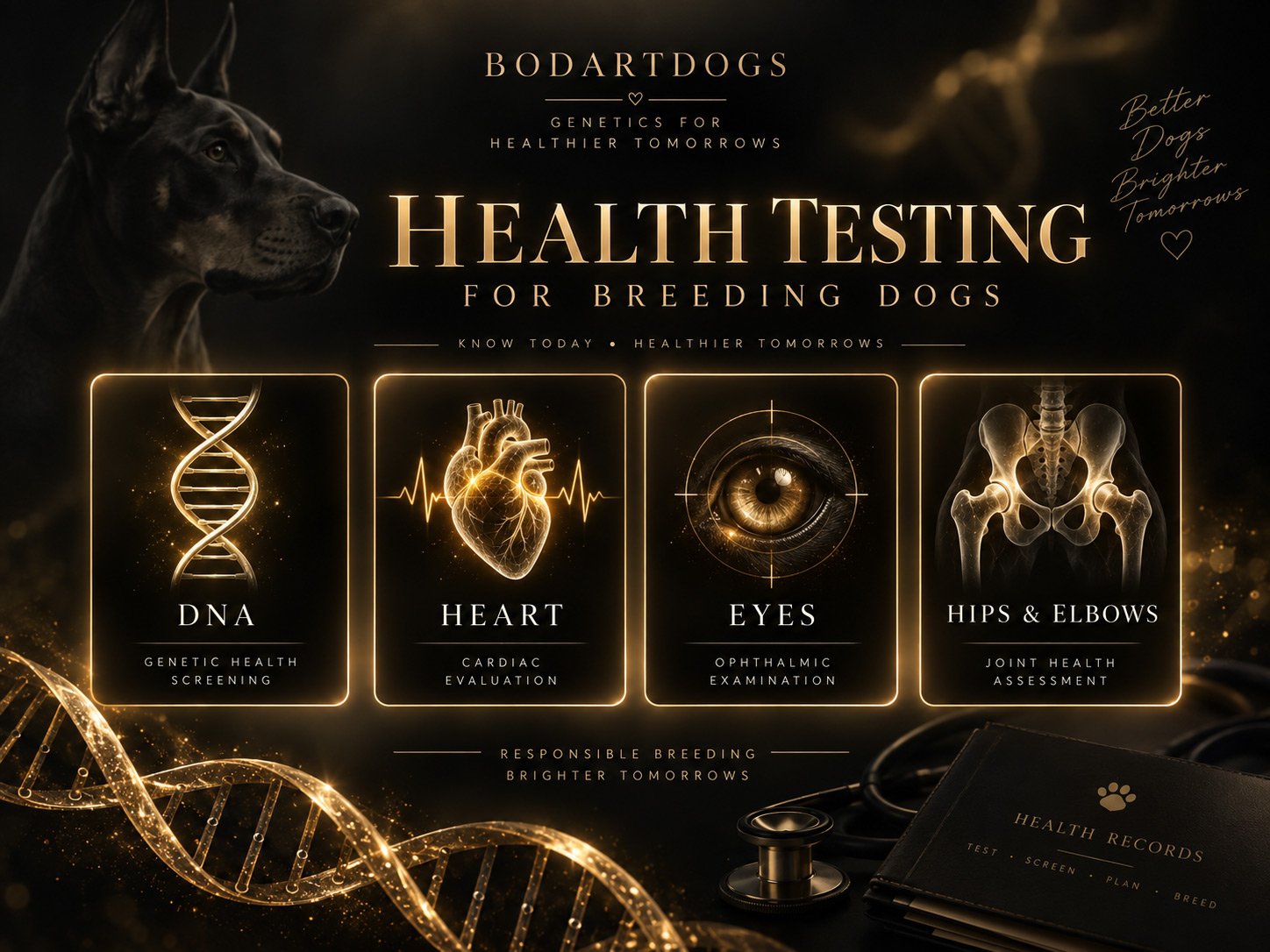
Health testing is most useful when it changes a breeding decision. Certificates and database entries matter, but the real purpose is to understand the strengths, limitations and known risks of two potential parents before a mating takes place.
That requires more than ordering a DNA panel. Some inherited conditions can be assessed with a direct genetic test; others need radiographs, specialist examinations or repeated clinical screening. The appropriate programme varies by breed, country, registry and family line, and it changes as evidence develops.
What Does Health Testing for Breeding Dogs Include?
“Health testing” is an umbrella term. A responsible pre-breeding assessment may combine several different types of evidence:
- DNA or genetic tests look for a defined variant, mutation or marker associated with a particular condition or trait.
- Clinical examinations assess the dog as it presents at the time of examination—for example, an eye examination by a veterinary ophthalmologist or a cardiac examination by an appropriately qualified clinician.
- Imaging-based screening uses radiographs, ultrasound, MRI or other imaging methods under a recognised protocol. Hip and elbow schemes are familiar examples.
- Phenotype-based screening records an observable or measurable feature rather than a DNA variant. This can include joint conformation, respiratory function, hearing or other breed-relevant assessments.
- Breed-specific health schemes combine tests selected for the documented risks and priorities of a particular breed population.
These methods answer different questions. A DNA result describes genotype at a tested location. A clinical or imaging result describes phenotype at a particular age and under a defined examination protocol. Neither should be used as a substitute for the other when both are relevant.
DNA Testing and Genetic Screening
A well-validated DNA test can identify whether a dog carries a specific disease-associated variant. For a simple autosomal-recessive condition, this may allow breeders to plan matings that do not produce genetically affected puppies. Other tests may relate to dominant, X-linked, mitochondrial or risk-associated inheritance and require different interpretation.
A result applies to the variant and inheritance model named on the report. “Clear” does not mean free from all hereditary disease, and a broad panel does not necessarily test every causal variant in a gene or every condition relevant to the breed. The strength of the variant–disease association, penetrance, laboratory method and evidence in the breed all matter.
For a detailed explanation of recessive results, see what clear, carrier and affected mean in dog genetic tests. Carrier status is often compatible with responsible breeding when the condition is genuinely recessive, the mate is appropriately tested clear and current breed guidance supports that strategy.
DNA testing is powerful because the genotype does not normally change with age. Its limitation is equally important: it only reports what the assay is designed and validated to detect.
Hip and Elbow Screening
Hip and elbow dysplasia are not managed through a single universal DNA test. Recognised screening schemes assess joint phenotype, usually from carefully positioned radiographs that are evaluated under a standard protocol.
The reporting system depends on the scheme. One organisation may provide a numerical score for each hip component, another a grade or classification, and another a measurement of joint laxity. Minimum ages, positioning requirements, sedation rules and publication policies also vary. Results from different systems should not be treated as interchangeable without understanding how each scheme works.
For breeders, the useful question is not simply whether a certificate exists. Consider the actual result, the breed distribution or current breed recommendation, the quality and completeness of family data, and whether estimated breeding values are available. A single dog’s radiographic phenotype is informative, but relatives and population data can improve the picture for a complex trait.
There is no responsible worldwide “acceptable score” that applies to every breed and every scheme. Use the rules and guidance of the relevant national kennel club, veterinary scheme and breed-health programme.
Eye, Heart and Other Clinical Examinations
Some inherited or breed-associated conditions are best detected by examination. Eye schemes can identify ocular abnormalities visible to a specialist, while cardiac screening may involve auscultation, echocardiography, electrocardiography or ambulatory monitoring depending on the condition and programme.
Timing matters. A normal examination describes the dog at that age; it cannot always exclude a late-onset condition. This is why some eye and heart programmes recommend repeat examinations, including an assessment within a defined period before mating. Other tests are performed once after a minimum age. The correct interval is condition- and scheme-specific.
Additional breed-relevant assessments may include hearing tests such as BAER, patellar evaluation, thyroid testing, respiratory function grading, spinal imaging or other specialist schemes. Their value depends on the health priorities of the breed rather than on how many certificates can be collected.
Breed-Specific Testing Matters
Ordering every test advertised for dogs is not automatically thorough. A variant may be absent from a breed, extremely rare, poorly validated in that genetic background or unrelated to a meaningful health concern. Conversely, a clinically important breed risk may have no DNA test and may be missed if the breeder relies only on a commercial panel.
Start with current recommendations from the relevant kennel club, national breed club, breed-health co-ordinator or recognised health programme. In North America, OFA’s CHIC programme develops breed-specific screening protocols with participating parent clubs. In the United Kingdom, the Royal Kennel Club Health Standard and breed pages list relevant schemes. Other countries have their own systems and may use different tests or thresholds.
Then add family-line knowledge. If a condition has occurred among close relatives, discuss whether additional screening, later testing or specialist advice is warranted even when it is not listed as a general breed requirement. Recommendations should be reviewed before each breeding generation because tests and evidence change.
How Should Breeders Interpret Results?
Different tests produce different types of results, and each needs its own decision framework:
- Pass/fail or normal/abnormal: check what was examined, the criteria applied and how long the result remains current.
- Numerical scores: interpret them within that scheme and breed population. Do not compare raw numbers from unrelated systems.
- Clear, carrier or affected genotype: confirm the exact variant and inheritance pattern before planning a mating.
- Risk result: determine whether the test estimates susceptibility rather than diagnosing inevitable disease, and review penetrance and breed validation.
- Phenotypic result: note the dog’s age, examiner, protocol and whether repeat assessment is recommended.
A result should be read in context with the proposed mate. Two individually acceptable dogs may still form a poor combination if they concentrate the same risk, while a carefully selected pairing can sometimes use a carrier without producing affected puppies. Record the original certificates and laboratory reports, not only a simplified summary.
Build a Health Record, Not a Certificate Collection
A useful breeding record identifies the dog unambiguously and preserves the information needed for later interpretation. Keep the registered name, registration number, microchip or other permanent identification, laboratory or examining body, date, method, actual result and a copy of the original report. If a result is submitted to an official public database, retain that link as well.
Separate permanent results from time-limited observations. A direct DNA genotype usually remains the same, although scientific interpretation can change. An eye or cardiac examination may only be current for a defined period. A spreadsheet or kennel database should therefore record due dates and not merely display a green tick.
Record relevant outcomes after breeding too. Litter size, birth difficulties, neonatal survival, later diagnoses and verified results from offspring and siblings can reveal patterns that were not apparent before the mating. This feedback makes the next decision better and contributes to breed knowledge when shared responsibly with health programmes.
Health Testing Does Not Guarantee a Healthy Litter
Health testing reduces uncertainty; it does not remove it. Many disorders are polygenic or multifactorial, meaning that several genes and environmental factors contribute. Unknown variants remain, some associations have incomplete penetrance, and new spontaneous mutations can occur. Pregnancy, birth, neonatal development and later life also involve risks that pre-breeding tests cannot predict completely.
The honest statement is therefore that the parents completed specified tests with stated results—not that a mating is guaranteed to produce healthy puppies. Transparent breeders explain what has been tested, provide verifiable results and acknowledge the limits of present knowledge.
Questions to Ask Before Planning a Mating
- Which tests are currently recommended or required for this breed in the relevant country and registry?
- Are the sire’s and dam’s results current, complete and independently verifiable?
- Does each result describe genotype, phenotype or estimated risk?
- Was the dog old enough for the result to be meaningful, and is repeat testing due?
- What does the actual score or grade mean within this breed and scheme?
- Are there relevant conditions in siblings, parents, previous offspring or the wider family?
- Does the proposed pairing avoid known high-risk combinations without unnecessarily narrowing genetic diversity?
- What health information will be recorded and communicated to puppy owners?
Final Takeaway
Health testing for breeding dogs is a structured evidence-gathering process, not a box-ticking exercise. DNA tests, imaging, clinical examinations, family history and breed-specific schemes each contribute different information. The breeder’s responsibility is to understand those differences and use the combined evidence to choose the most defensible mating available.
The best programme is therefore not the longest list of tests. It is the current, breed-relevant set of reliable assessments, completed at the correct age, interpreted accurately and followed by honest recording of outcomes. That approach supports individual litters while steadily improving the information available to the wider breeding population.
For more breeder-focused resources, visit the BodArtDogs blog.
This article is general educational information. Test selection and interpretation should be discussed with the relevant veterinary surgeon, specialist, laboratory and breed-health organisation.