
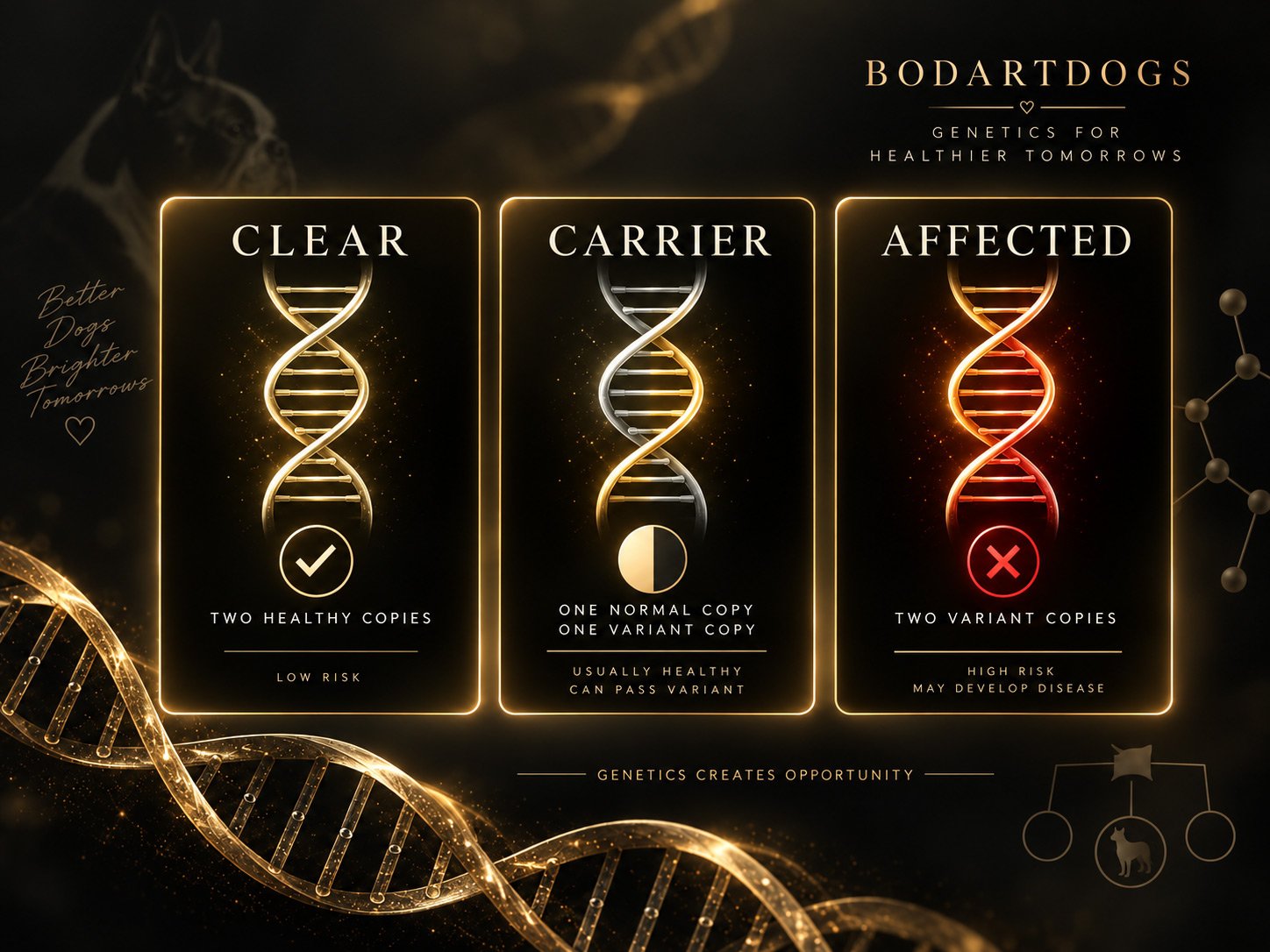
Genetic test reports can look deceptively simple. A breeder sees “clear”, “carrier” or “affected” and may be tempted to treat the label as a complete judgement on the dog. It is not. Each result describes the dog’s genotype for a particular tested variant, interpreted under a particular inheritance model. Used carefully, that information can help avoid preventable disease while preserving the qualities and diversity of a breed population.
The essential question is therefore not only what result did the dog receive?, but also what exactly was tested, how is the condition inherited, and how reliable is the link between that variant and disease in this breed?
What Does a DNA Test Actually Tell You?
Most canine DNA health tests look for one defined genetic variant: a change at a particular position in the DNA that research has associated with a disease or trait. The laboratory compares the dog’s DNA with the versions it is designed to detect and reports the genotype at that location.
This is different from assessing the dog’s whole genetic health. A “clear” result normally means that the tested variant was not detected. It does not rule out other disease-causing variants in the same gene, variants in other genes, conditions for which no test exists, or illnesses influenced by many genes and the environment.
It is also important to separate genotype from phenotype. Genotype describes the DNA versions a dog carries. Phenotype describes what can be observed or measured: clinical signs, age of onset, examination findings or screening results. For some well-established variants, genotype predicts phenotype very strongly. For others, penetrance may be incomplete, severity may vary, or the association may be less certain outside the breed in which it was discovered.
The familiar terms clear, carrier and affected are most straightforward for a simple autosomal-recessive condition. They must not be transferred automatically to dominant, X-linked, mitochondrial, risk-associated, polygenic or linkage-based tests. Always read the laboratory’s interpretation for that specific test.
What Does Clear Mean?
For a typical direct DNA test for a simple autosomal-recessive condition, a clear dog has two copies of the normal version at the tested position. We can write this as N/N. The disease-associated variant covered by the test was not detected, so the dog cannot pass that particular variant to its puppies.
That is valuable information, but its boundary matters. The dog is clear for the tested variant, not “genetically clear” in a general sense. The result says nothing by itself about hip or elbow status, eye examination findings, cardiac screening, fertility, longevity, temperament, conformation or hereditary risks that are not captured by that test.
Even the wording “clear by parentage” requires care. Parentage must be secure, both parents must have appropriate direct-test results, and registry rules may limit how many generations the inference can be carried forward. A linkage test, which follows a nearby marker rather than the causal variant itself, also has a small possibility of recombination and should not be interpreted as if it were a direct mutation test.
What Does Carrier Mean?
In the same simple recessive model, a carrier has one normal copy and one copy of the tested disease-associated variant: N/v. A carrier can pass either copy to a puppy, so each puppy has a 50% probability of inheriting the variant from that parent.
Carriers of a fully recessive condition are usually clinically unaffected because the normal copy provides sufficient function. “Usually” and “for this condition” are important qualifications. A laboratory may use different terminology where carriers can show mild features, where inheritance is not completely recessive, or where other genes modify expression. The report and current disease-specific evidence take precedence over a generic definition.
A carrier result is therefore not a diagnosis of disease and not, by itself, a reason to discard an otherwise valuable dog from a breeding programme. It is information that must shape mate selection and record keeping.
What Does Affected Mean?
For a simple autosomal-recessive disorder, a dog with two copies of the disease-associated variant has the genotype v/v. Laboratories or registries may call this “affected”, “genetically affected” or “at risk”. Such a dog will pass one copy of the variant to every puppy.
The genotype may strongly predict clinical disease, but it does not always tell you whether signs are present today, when they will begin or how severe they will be. Age of onset, incomplete penetrance, variable expression, modifier genes, environment and the strength of the original variant–disease evidence can all matter. This is why a genetically affected result and a clinically affected phenotype should not be treated as interchangeable without checking the condition.
An affected or at-risk result warrants disease-specific veterinary advice. If breeding is considered at all, the dog’s welfare, the condition’s clinical consequences and the relevant breed-health guidance must be central to the decision.
How Clear, Carrier and Affected Dogs Can Produce Different Puppies
The table below applies only to a simple autosomal-recessive condition with complete Mendelian inheritance. “Clear” means N/N, “carrier” means N/v and “affected genotype” means v/v.
| Mating | Expected clear puppies | Expected carrier puppies | Expected affected-genotype puppies |
|---|---|---|---|
| Clear × Clear | 100% | 0% | 0% |
| Clear × Carrier | 50% | 50% | 0% |
| Carrier × Carrier | 25% | 50% | 25% |
| Clear × Affected | 0% | 100% | 0% |
| Carrier × Affected | 0% | 50% | 50% |
| Affected × Affected | 0% | 0% | 100% |
These percentages are probabilities for each puppy, not a promise about the exact composition of one litter. A four-puppy litter from two carriers is not guaranteed to contain one clear, two carriers and one affected puppy. Each conception is a new genetic event, and small litters can differ considerably from the expected ratio.
The table also does not apply unchanged to dominant variants, sex-linked inheritance, mitochondrial inheritance, incomplete penetrance, complex risk haplotypes or polygenic disease. If a report does not explicitly describe the condition as simple autosomal recessive, do not plan a mating from this table alone.
Does a Carrier Dog Have to Be Removed from Breeding?
Not automatically. For a well-validated simple recessive test, mating a carrier to a tested-clear dog prevents affected-genotype puppies, although approximately half the puppies are expected to be carriers. Testing retained offspring allows the breeder to select clear descendants over subsequent generations without abruptly removing an entire family line.
This matters because selection acts on a population, not just an individual result. If every carrier is excluded immediately—especially in a numerically small breed or where the variant is common—the effective breeding population can shrink. Valuable diversity and desirable qualities may be lost, while the use of a smaller number of clear dogs can increase relatedness and expose other, previously uncommon recessive risks.
A balanced plan may therefore use a high-quality carrier with a suitable clear mate, avoid producing affected puppies, test relevant offspring and gradually reduce the variant’s frequency. That is different from ignoring the result or repeatedly concentrating the variant through popular sires.
The appropriate strategy depends on the disease’s severity and penetrance, the accuracy and breed relevance of the test, variant frequency, population size, available mates and the breed club or health programme’s recommendations. Welfare comes first; genetic diversity is part of that welfare calculation, not an excuse to make a known high-risk mating.
Why “Clear” Does Not Mean Genetically Perfect
No DNA panel covers every hereditary risk. New variants continue to be discovered, existing associations are reassessed, and some tests are relevant only in particular breeds or lineages. A clear panel may simply mean that none of the variants included in that panel was detected.
Many important conditions are also polygenic or multifactorial. Hip and elbow dysplasia, for example, cannot be reduced to a single clear/carrier/affected result. Their evaluation relies on phenotype-based screening and population data, while environmental factors can also influence expression. Eye examinations, cardiac assessments and other breed-specific clinical schemes answer different questions from a DNA swab.
Conversely, a dog carrying one known recessive variant may still be an excellent representative of the breed with strong health, temperament, working ability, conformation and pedigree value. Good breeding decisions integrate all of those data rather than allowing one laboratory label to replace the whole dog.
Questions Breeders Should Ask Before Using a Genetic Test Result
- What exact variant was tested? Is it a direct test for a causal variant or a linkage/marker test?
- What inheritance pattern applies? Is it simple autosomal recessive, dominant, X-linked, mitochondrial, risk-associated or more complex?
- How strong is the variant–disease association? Consider penetrance, age of onset, clinical severity and whether the evidence has been replicated.
- Is the test validated and relevant for this breed? A variant found in one breed may not have the same clinical meaning in every genetic background.
- Was the sample and identity process reliable? Check laboratory accreditation or quality standards, sample collection, microchip verification where relevant and parentage records.
- What do the breed club, kennel club and health programme recommend? Current breed-specific guidance should inform how quickly a variant is reduced without damaging population diversity.
- What other health tests are relevant? Combine DNA results with broader health testing for breeding dogs, pedigree information, coefficients of inbreeding, family health history and the proposed mate’s results.
- What is the plan for the offspring? Decide in advance which puppies will be tested, how results will be disclosed and how retained breeding stock will be selected.
Keeping the original laboratory report with the dog’s health records is good practice. Record the variant, laboratory, test date, result and identity verification—not just the word “clear”. This gives future breeders enough information to interpret the result correctly as knowledge and testing methods change.
Final Takeaway
Clear, carrier and affected are useful terms only when tied to the specific variant and inheritance model being tested. In a simple autosomal-recessive condition, they can make inheritance risk predictable and help breeders avoid affected puppies. Outside that model, the same words may oversimplify the biology.
Genetic testing is a decision-support tool, not a verdict on the dog and not a substitute for the pedigree, clinical health data, breed population and proposed mating. The strongest breeding plans use DNA results precisely: prevent known disease, retain useful diversity, document decisions and follow current veterinary and breed-specific advice.
For more practical, science-informed breeder resources, visit the BodArtDogs blog.
This article provides general educational information for breeders. It does not replace advice from a veterinary surgeon, veterinary geneticist, testing laboratory or relevant breed-health programme.
Sources & Further Reading
- The Royal Kennel Club: Understanding and using your dog’s DNA test results
- Orthopedic Foundation for Animals: Frequently asked questions on health testing
- Orthopedic Foundation for Animals: Policies, including clear by parentage
- Donner et al. (2023): Genetic prevalence and clinical relevance of canine Mendelian disease variants in over one million dogs