
A coefficient of inbreeding can look like a precise verdict: one mating is 3.8%, another 12.4%, and a genomic report gives a third figure. The numbers are useful, but only when a breeder knows what was calculated, from which data and for what purpose.
COI is not a quality score for a dog. It is a measure of relatedness and expected or observed homozygosity. It helps describe genetic risk at individual and population level, but it does not replace health results, knowledge of the family or evaluation of the dogs themselves.
What Does COI Mean?
The coefficient of inbreeding estimates the probability that the two copies of a gene at a location are identical by descent: both copies trace back to the same ancestral copy through the sire and the dam. A higher pedigree COI means a greater expected proportion of such paired copies across the genome.
In practical terms, related parents have inherited some of the same DNA from shared ancestors. Their puppy has a chance of receiving the same ancestral copy through both parental lines. COI summarises that probability across the pedigree; it does not identify which particular genes are homozygous or whether a disease-causing variant is among them.
A pedigree calculation is therefore an expectation. Recombination and the random transmission of chromosomes mean that littermates from the same mating do not receive identical segments. They share the same predicted pedigree COI, but their realised genomic homozygosity can differ.
Why Related Dogs Increase COI
Every puppy receives one set of chromosomes from each parent. If the parents share an ancestor, both may carry DNA copies that originated from that ancestor. The more closely related the parents are, and the more often the same ancestors appear through both sides, the greater the probability that the puppy receives matching ancestral copies.
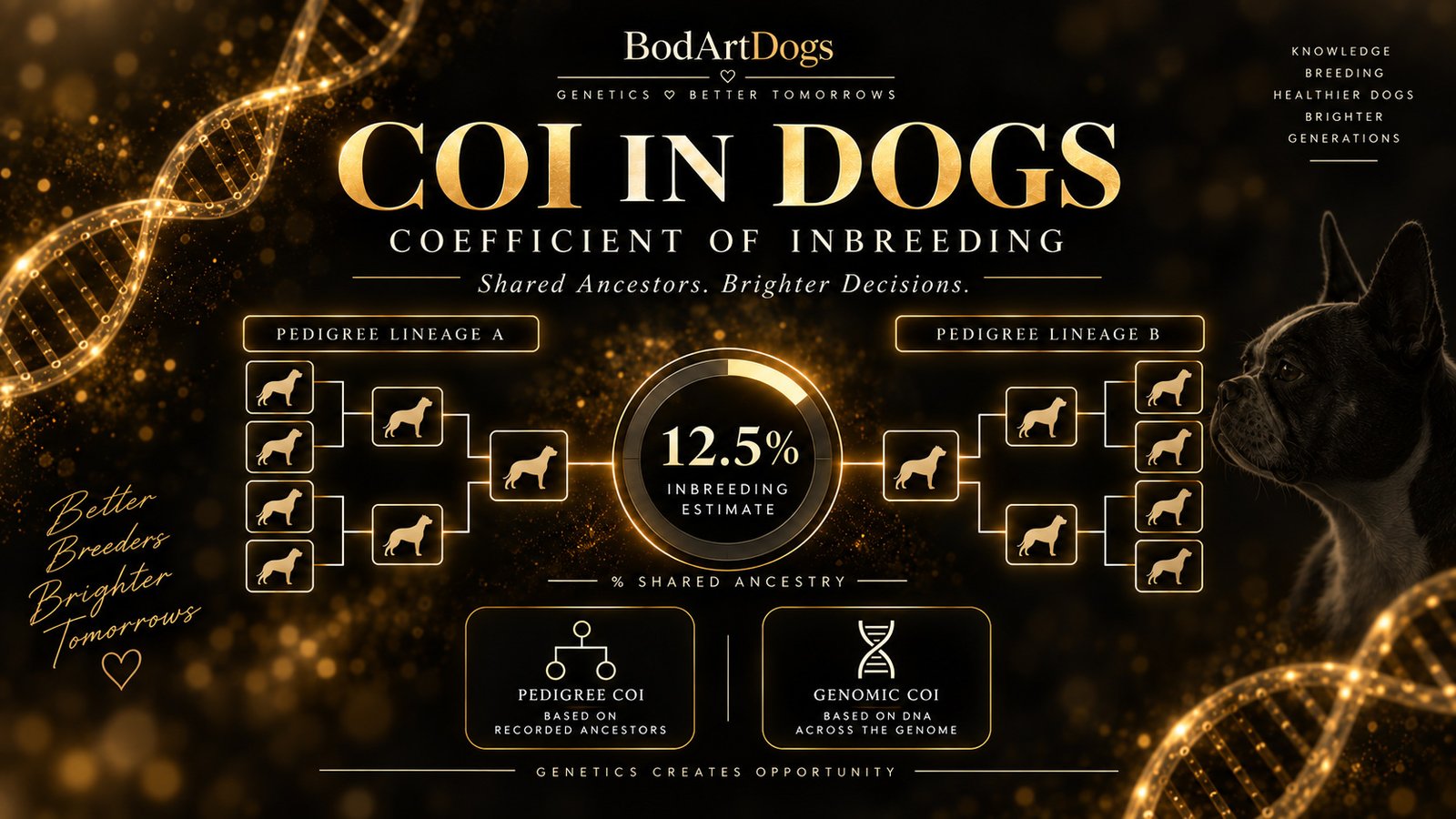
Close matings have familiar theoretical values when the ancestors themselves are assumed unrelated: a parent–offspring or full-sibling mating produces an expected COI of 25%, while a half-sibling or grandparent–grandchild mating produces 12.5%. Real pedigrees can give higher values because earlier generations may already contain inbreeding and repeated ancestors.
These examples explain the scale; they are not universal breeding thresholds. A 6% result calculated from ten complete generations is not equivalent to 6% calculated from only three incomplete generations.
Pedigree-Based COI
Pedigree COI is calculated from recorded ancestry. It asks how often common ancestors connect the sire’s and dam’s lines and how those relationships contribute to the expected inbreeding of their offspring.
The quality of the answer depends on the quality of the pedigree:
- Depth: a calculation using three generations cannot detect common ancestors that appear in generations four, five or beyond.
- Completeness: missing parents are usually treated as unrelated founders, which can make the result look lower than it would with complete records.
- Identity accuracy: spelling variations, duplicate records or incorrect parentage can break or create pedigree links.
- Founder assumptions: the earliest recorded dogs are commonly assumed unrelated even when their real relationships are unknown.
A database that uses all available electronic pedigree records will usually give a more informative estimate than a simple five-generation calculator, provided the deeper data are reliable. Breeders should record the database and generation completeness alongside the percentage.
Genomic COI
Genomic inbreeding is estimated directly from DNA markers. One common approach measures runs of homozygosity: long chromosome segments where the dog inherited matching DNA from both parents. The proportion of the genome within qualifying runs can be reported as an inbreeding estimate.
This measures realised genomic patterns rather than the average expected from a pedigree. It can detect relationships that are missing from records and distinguish littermates whose inherited segments differ by chance. However, it is still method-dependent. Marker density, genotyping platform, quality control, the minimum length used to define a run and the reference population can all change the result.
Some laboratories calculate genomic inbreeding from homozygosity relative to expected allele frequencies rather than from runs of homozygosity. Two reports both labelled “genetic COI” may therefore use different equations and should not be assumed directly comparable.
Why Two COI Numbers May Not Be Comparable
Before comparing percentages, check whether they describe the same quantity and were produced from comparable data.
- Different pedigree databases may contain different ancestors, imported dogs or corrections.
- Different pedigree depths identify different numbers of common ancestors.
- Different completeness levels change how many founders are treated as unrelated.
- Pedigree and genomic methods compare expected identity by descent with observed DNA patterns.
- Different genomic platforms and algorithms may define homozygous segments differently.
- Different reference populations affect frequency-based genomic estimates and breed-average comparisons.
For practical tracking, use the same well-documented tool across candidate matings where possible. If changing systems, keep the old and new values separate rather than treating the series as continuous.
Expected Versus Realised Homozygosity
Imagine a mating with a pedigree COI of 10%. That value describes the expected probability across many possible offspring under the pedigree assumptions. It does not mean that exactly 10% of every puppy’s genome can be identified as homozygous because of the same ancestors. Mendelian sampling gives each puppy a different combination of parental chromosome segments.
A genomic result observes the segments that the individual actually inherited, subject to the test’s marker coverage and algorithm. This is why littermates can share one pedigree COI but receive different genomic estimates. Neither result is “wrong”; they describe expectation and realisation through different evidence.
Genomic homozygosity can also reflect distant breed history that is not visible in a short pedigree. Pedigree analysis, in contrast, identifies the named ancestors and pathways responsible for recent relatedness. For breeders, the methods are complementary: genomic data measures the dog, while pedigree data helps explain and plan relationships.
Using a Breed Average Carefully
A breed average is useful only when the proposed mating and the average were calculated from the same database and method. Check which birth years, country or registry population are included. A historical average, a current annual average and a global genomic sample may describe very different populations.
The average is a reference point, not a biological safety line. In a highly inbred breed, an average mating may still continue loss of diversity. In a small population, an unusually low result could rely on an imported or poorly documented line. Ask whether the proposed litter improves the range of realistic choices available to the next generation, not only whether it passes today’s comparison.
Does a Low COI Automatically Mean a Better Mating?
No. A lower comparable COI generally means less expected inbreeding, but a mating is not responsible simply because the percentage is low. Apparently unrelated dogs can carry the same disease-associated variant, share the same structural weakness or combine unsuitable temperaments. A low pedigree COI may also be misleading when the pedigree is incomplete.
COI should sit beside—not above—other evidence: breed-relevant health testing, clinical health, temperament, conformation, working ability, reproductive fitness, pedigree information, family longevity and the population’s available diversity. The aim is a balanced combination, not the lowest number at any cost.
Breed context matters. Comparing a proposed litter with a current, consistently calculated breed average can be more useful than applying an arbitrary worldwide cut-off. Even then, an average describes the population; it does not automatically make every below-average mating good or every above-average mating unacceptable.
Inbreeding Depression and Genetic Diversity
Inbreeding increases homozygosity. This can expose recessive deleterious variants when a puppy inherits two copies, including variants for which no commercial test exists. Across populations, rising inbreeding is also associated with inbreeding depression: reduced average performance in fitness-related traits such as fertility, litter size, survival or longevity.
The effect is statistical, not a prediction that every higher-COI dog will be ill or every low-COI dog healthy. The variants present, the population’s history and random inheritance influence individual outcomes. COI expresses risk and population structure; it does not diagnose disease.
Genetic diversity also includes which variants remain in the population, not only whether individual dogs are relatively outbred. A breed could produce several low-COI litters while still losing rare lines if the same small group of animals dominates reproduction.
The Popular Sire Effect
A successful sire can produce many more descendants than a dam. If one male is used extensively, his genes—including any unknown harmful variants—can spread rapidly. Future generations then contain more relatives, making genuinely different mating options harder to find.
The immediate litters may have acceptable COIs, yet the long-term population effect can be substantial when many of those offspring are bred. Breeders should therefore consider not only a sire’s current COI and quality, but also his existing contribution, number of breeding descendants and representation of his line within the breed.
How Breeders Can Use COI Practically
- Record whether each figure is pedigree-based or genomic.
- For pedigree COI, note the database, number of generations and completeness.
- For genomic COI, identify the laboratory, platform and method if supplied.
- Compare candidate matings within the same calculation system.
- Check repeated ancestors and their health, traits and population contribution rather than relying on the percentage alone.
- Compare with a current breed average only when it was calculated by the same method and from a relevant population.
- Review health tests, family history, temperament, phenotype and working information for both dogs.
- Consider how many related offspring and descendants are already being bred.
- Retain records so changes in the population can be monitored across generations.
Final Takeaway
COI in dogs is a valuable description of inbreeding risk, but the percentage is meaningful only with its method and data. Pedigree COI estimates expected identity by descent from recorded ancestors; genomic measures estimate realised homozygosity from DNA. They answer related but not identical questions.
Use COI to compare well-documented mating options, identify avoidable concentration and protect population diversity. Then place it beside the dogs’ health, temperament, phenotype, ability and family information. Good breeding decisions are multi-dimensional, even when one number is easy to display.
Explore more practical genetics and pedigree resources on the BodArtDogs blog.
This article is educational information. Interpretation should take account of the relevant breed population, database, laboratory method and current breed-health guidance.