
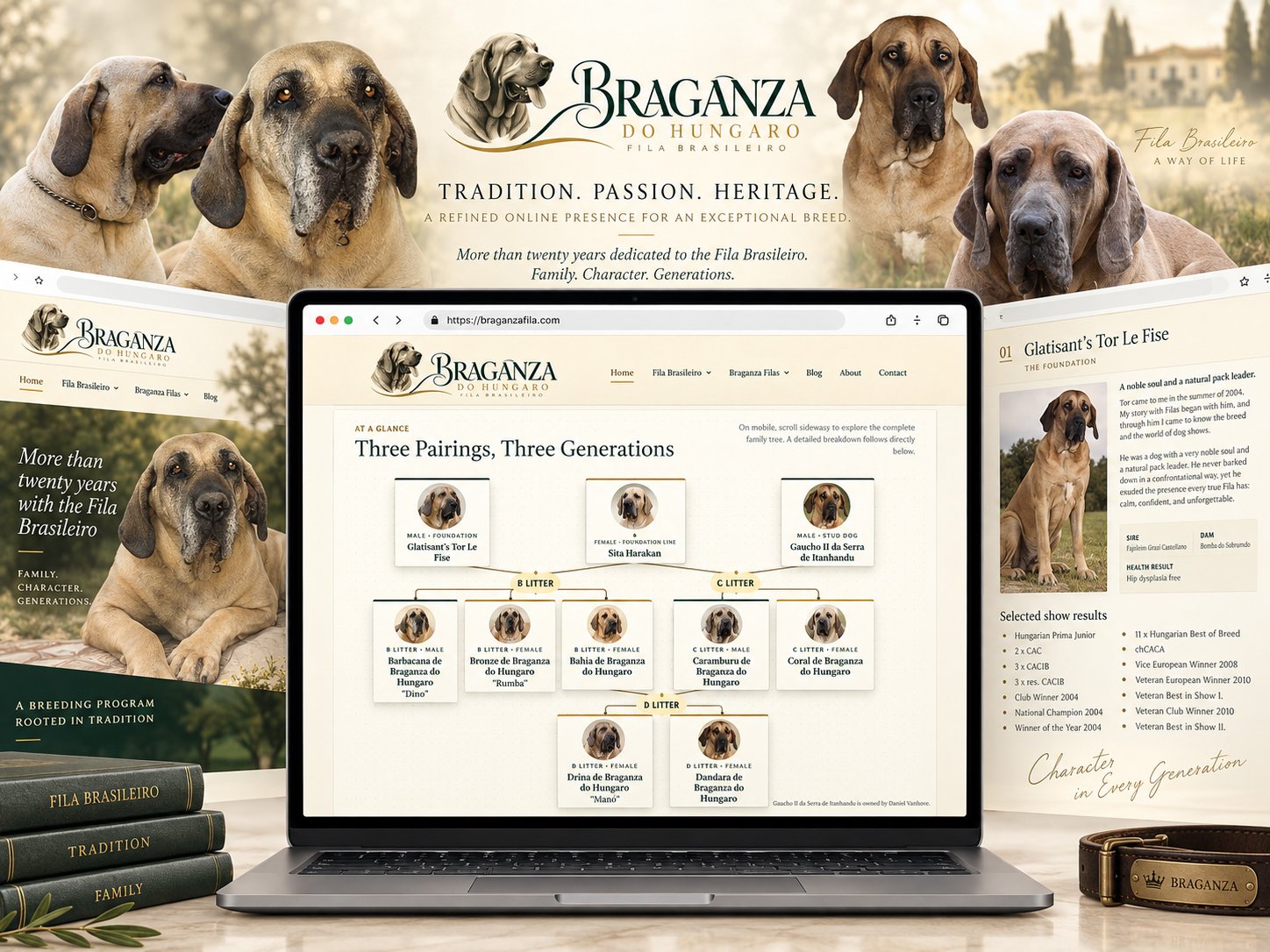
A kennel website is more than an online business card. It can explain your breeding philosophy, introduce your dogs, make pedigree and health information accessible, and guide suitable enquiries towards a useful conversation. Done well, it also answers questions you would otherwise repeat in messages.
So, what should a dog breeder website include? For most kennels, the starting point is a clear homepage, meaningful information about the breeder, a presentation of the dogs, relevant litter information and an easy way to enquire. Profiles, pedigrees, results and educational content add value when they serve a real purpose.
A good breeder website should be structured around the kennel, its dogs and breeding programme, and the information visitors actually need. That can mean a compact website or a larger archive. The number of pages is not the measure of quality.
Start With the Purpose of the Website
Decide who you want to help before drawing up a page list. Future puppy owners may need information about the breed, your expectations and the enquiry process. Other breeders may want pedigrees, health records and details of your breeding dogs. Stud enquiries need a different route from general breed questions.
A kennel active in showing or working events may also want to document qualifications and achievements. You can serve several audiences, but give each a clear path. For example, “Our Dogs”, “Litters” and “Puppy Enquiries” are easier to navigate than one long page mixing everything together.
A Homepage That Explains Your Kennel Quickly
Visitors should quickly understand your kennel name, breed, country or region, and the focus of your breeding programme. A brief introduction, genuine photographs and links to the main sections usually work better than a lengthy welcome message.
Show the next steps clearly: meet the dogs, read about the kennel, view relevant litter information or make an enquiry. Include a current litter or important update when appropriate, but date it and keep it accurate. The homepage introduces the website; it does not need to contain every pedigree, certificate and result.
About the Kennel: Specifics Build Credibility
“We love dogs” tells visitors very little about your breeding decisions. Explain how your involvement with the breed began, what you aim to preserve or improve, and what experience informs your programme. Include relevant show or working experience and your approach to health screening.
Concrete details are more useful than broad claims. Describe your priorities in temperament, function or conformation and how they relate to the breed. Distinguish established experience from future plans. A short, honest account of a small kennel is stronger than an impressive-sounding history that visitors cannot verify.
Breeding Dogs and Individual Dog Profiles
Your dogs are central to the website. A shared page may be enough for a small kennel. Individual profiles become useful when each dog has substantial pedigree, health, breeding or results information. Keep current breeding dogs, retired dogs and historical records clearly identified.
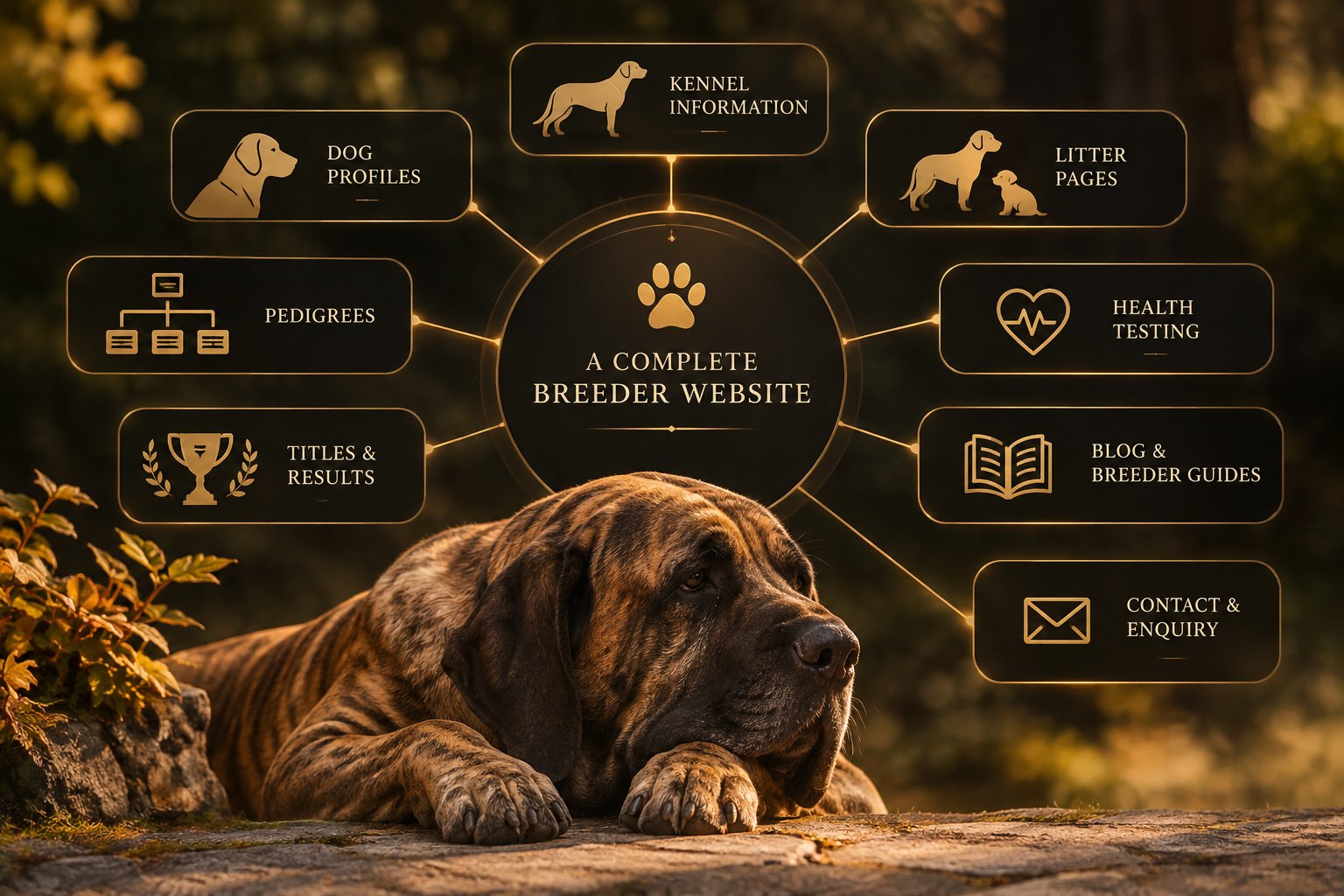
A useful profile can include:
- Registered name and call name.
- Sire, dam and a pedigree or reliable pedigree link.
- Health screening and genetic test results, with sources.
- Titles and selected show or working results.
- Clear photographs and practical breeder notes.
- Stud availability and an enquiry route, where relevant.
Describe temperament and qualities from your experience without presenting observations as formal assessments. Use consistent labels across profiles, so readers can find the same information on each dog. Copy test results accurately rather than interpreting abbreviations or genetic findings without a reliable professional source.
Pedigrees and Breeding Relationships
Pedigree information helps visitors understand ancestry and connections within your programme. Other breeders can use it as a starting point for their own evaluation. It also makes relationships easier to follow when similar registered names recur across generations.
You might use a readable pedigree, a structured family tree, parentage information or a link to a trusted external database. You do not need to develop your own pedigree database. Check names carefully, identify the dog the pedigree belongs to, and provide an accessible alternative if the information appears only in an image. Do not present pedigree information alone as proof of health or breeding suitability.
Health and Genetic Testing: Present Results Precisely
Show which tests were performed, the reported results, the testing organisation and relevant dates. Link to recognised records when available. Keep health screening, DNA health tests and identification or parentage profiles clearly labelled rather than grouping everything under “DNA tested”.
Testing priorities depend on the breed. The Royal Kennel Club’s health-screening guide directs breeders to breed-specific recommendations. A website can explain your testing approach and present records, but it does not replace veterinary or genetic advice.
Explain schemes accurately. For example, OFA states that a CHIC number records completion and public disclosure of the required breed-specific testing; it does not mean every result is normal. Link to the individual results rather than relying on the number as a stand-alone health claim.
Avoid descriptions such as “genetically perfect”, “completely healthy bloodline” or “guaranteed healthy puppies”. Specific, traceable results are more informative than reassurance that exceeds the evidence.
Planned, Current and Previous Litters
Planned Litters
Identify the proposed sire and dam, expected timing and relevant pedigree or health information. Make the status explicit: a planned mating, a completed mating and a confirmed pregnancy are different stages. Link the parents to their profiles instead of duplicating every detail.
Current Litters
Include the birth date, parent information and appropriate updates. If you show puppy availability, keep it current and provide a clear enquiry route. A dated update helps readers assess whether the information is recent. Remove or revise availability statements when circumstances change.
Previous Litters
An archive can document kennel history and breeding relationships. Include meaningful records, selected photographs or later achievements where relevant. Previous litters should be recognisable as historical information, not mistaken for puppies currently available.
Show, Working and Other Results
Organise achievements by dog, year or type of activity. Highlight important titles and qualifications, then offer more detail where it helps. Include the event, date and exact result rather than a disconnected list of abbreviations.
Expand unfamiliar titles at least once. Link results to the relevant dog profile so visitors can connect achievements with pedigree and health information. Keep awards, working qualifications and your own observations distinct. You can preserve a larger results archive without making every visitor scroll through it.
What Future Puppy Owners Need to Know
If puppy enquiries are part of your website’s purpose, explain how the process works. Tell readers what to include in their first message, how you discuss suitability, and what they should expect before a puppy is placed.
Describe your actual expectations and handover arrangements without promising procedures you have not established. Breed-specific considerations can help readers decide whether to enquire. Keep medical advice and contractual claims separate from general guidance, and use suitable professional sources when discussing those subjects. This information may fit within a litter page rather than requiring another section.
Contact and Enquiry: Make the Next Step Easy
Provide a contact form or email address and a suitable level of location information, such as country and region. Add relevant social links, but do not make visitors leave the website just to discover how to contact you.
A structured enquiry form can ask whether the message concerns a puppy, stud dog or general breed question. A few relevant fields help you respond with context. Avoid requesting an extensive personal history at the first step. Test the form on a phone, verify that messages reach you, and give visitors clear confirmation that their enquiry was submitted.
Blog or News: Do You Actually Need One?
A blog is useful when you have a purpose and a realistic plan to maintain it. Breed education, kennel news, litter updates and selected show or working reports can all be worthwhile. Health and genetics articles need careful sourcing and review.
You do not need a blog simply because other kennels have one. An abandoned news section can leave visitors unsure whether the kennel is still active. For occasional updates, maintaining your dog and litter pages may be sufficient. The BodArtDogs blog provides examples of breeder-focused educational topics, rather than a publication schedule every kennel must copy.
Trust Signals That Visitors Can Check
Use genuine photographs, a clear breeder identity, accurate registry information where appropriate, and accessible contact details. Support health statements and achievements with records or external links. Explain memberships precisely without implying endorsement beyond what the organisation provides.
Consistent presentation helps readers connect the evidence. Decorative badges and vague “trusted breeder” labels add little if visitors cannot establish who you are, which dogs are being discussed or where the results come from.
Mobile Usability Must Include Breeder Information
Check more than the homepage on a phone. Open dog profiles, pedigrees, health tables, galleries and the enquiry form. Important information should remain readable without sideways page scrolling or buttons that are difficult to tap.
A large family tree may need a zoomable version or a separate readable parentage summary. Preserve important connections instead of cropping them to fit a narrow screen. Check image loading, navigation and form feedback too. The visitor should be able to move from a litter to its parents and then to an enquiry without losing their place.
SEO Foundations for a Breeder Website
SEO foundations help visitors and search engines understand the website. Use descriptive page titles, logical URLs, meaningful headings and links between relevant pages. Describe informative images with appropriate alt text. Write useful content in natural language instead of repeating the same keyword throughout the page.
Before launch, check that intended public pages are indexable and that technical settings do not accidentally block them. A sitemap can help discovery, although it does not guarantee indexing or rankings. Mobile usability and clear content support the overall experience. Google’s SEO Starter Guide explains these foundations in more detail.
What a Breeder Website Does Not Necessarily Need
A kennel website does not automatically need twenty separate pages, an online shop, custom puppy-management software, complicated animations or an enormous gallery. Nor must it display every result ever earned. Additional features should solve an identifiable problem and be manageable after launch.
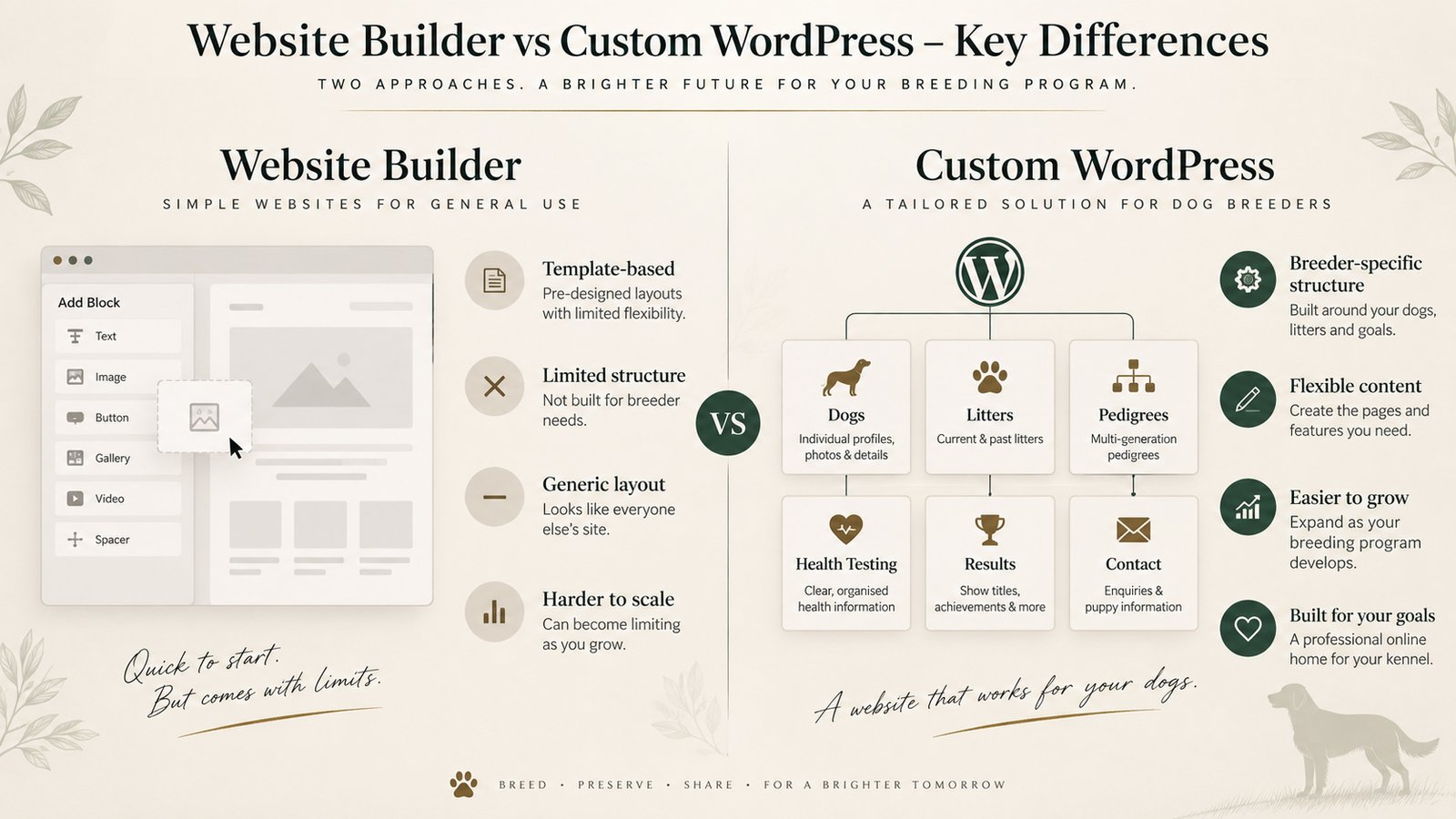
Build what supports the kennel, not what makes the website look technically impressive. If you are choosing a platform, our comparison of website builder vs custom WordPress considers that decision separately. Establish the content you need before selecting features.
Dog Breeder Website Checklist
Use this as a content checklist, not a requirement for separate pages. Several items can share one well-organised page.
Essential for Most Kennels
- A homepage explaining the kennel, breed and location.
- About information with a clear breeder identity and philosophy.
- A useful presentation of the dogs.
- Accurate litter information, where applicable.
- An easy, tested contact or enquiry route.
Often Valuable
- Individual dog profiles when the content warrants them.
- Readable pedigrees and traceable health information.
- Selected show or working results.
- Practical information for future puppy owners.
Depends on the Kennel
- A maintained blog or news section.
- Breed education and multilingual content.
- A previous-litter or historical dog archive.
- Advanced features with a defined purpose and maintenance plan.
Final Takeaway
A professional breeder website is understandable, credible and well organised. It presents the information people need and reflects the kennel’s real breeding work. Start with that content, connect it logically and expand only where there is a clear benefit.
For an example of how those needs translate into a service scope, see Dog Breeder Website Design. The right structure should make your breeding information easier to explore and maintain.
Need a website structured around your kennel?
BodArtDogs creates custom WordPress websites for dog breeders, built around dogs, litters, pedigrees, health information and professional breeder communication.
Sources & Further Reading
- Google Search Central — SEO Starter Guide: site structure, useful content, links and search fundamentals.
- OFA — CHIC Program: breed-specific screening, public results and the meaning of a CHIC number.
- Royal Kennel Club — Health Screening: A Step-by-Step Guide: breed-specific testing and finding recorded results.