
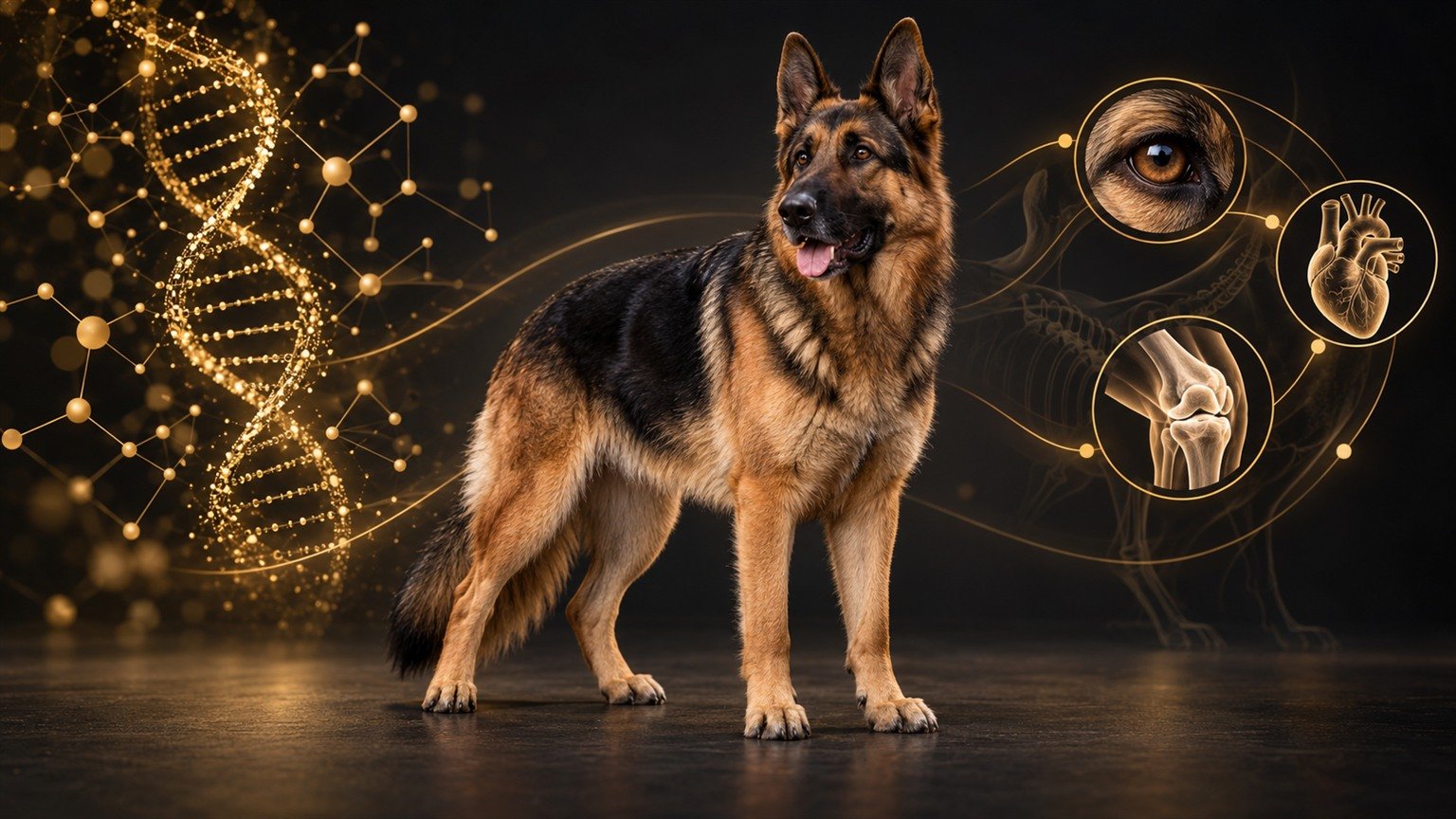
Health testing in breeding dogs is often discussed as if it were one single process. In reality, a DNA test, an eye examination, a cardiac evaluation and a hip assessment answer very different questions. For a broader framework, see Health Testing for Breeding Dogs: What Breeders Should Consider.
A DNA result may tell you whether a dog carries a particular genetic variant. A clinical or phenotype-based screening examines something that can be observed, measured or diagnosed in the dog itself. Neither approach gives a complete picture on its own.
For breeders, understanding this distinction matters because a long list of DNA results does not automatically replace clinical screening — and a normal clinical result does not tell you the dog’s genotype for every inherited condition.
The useful question is not:
Which type of testing is better?
It is:
What information does each type of test provide, what are its limitations, and which evidence is relevant to this breed and this breeding decision?
DNA Testing and Clinical Screening Answer Different Questions
At the simplest level, DNA testing examines genetic information.
A validated DNA health test may identify a specific variant associated with a particular inherited condition or risk. Depending on the disease and its mode of inheritance, the result may be reported using terms such as clear, carrier, affected or another risk classification.
Clinical and phenotype-based screening looks at the dog differently.
It may assess the structure or function of an organ or body system through methods such as:
- radiographic evaluation of hips or elbows;
- an ophthalmic examination;
- a cardiac examination;
- another specialist or scheme-based assessment.
Some health programmes combine both types of evidence. The OFA CHIC programme, for example, explicitly recognises that health screening requirements can include genetic tests as well as phenotypic evaluations, and that the appropriate combination varies by breed.
That distinction is fundamental.
A genotype and a phenotype are related, but they are not the same thing.
What Can a DNA Health Test Tell a Breeder?
A DNA test is designed to analyse genetic material.
For many canine health tests, the laboratory looks for a particular genetic variant known to be associated with a disease or trait. When the variant and its inheritance pattern are well understood, the information can be extremely useful for breeding decisions.
For example, DNA testing can help breeders identify dogs carrying certain recessive variants even when those dogs show no clinical signs themselves. This can allow breeders to plan combinations that avoid producing affected puppies while retaining useful genetic diversity rather than automatically removing every carrier from breeding.
DNA testing can therefore provide information that cannot be obtained simply by looking at the dog.
A clinically normal dog can still carry a recessive variant.
That is one of the major strengths of genetic testing.
A DNA Result Is Specific to What Was Tested
This is also its main limitation.
A DNA result answers a defined genetic question.
If a dog tests clear for one specific disease-associated variant, that means the tested variant was not detected according to the test’s methodology. It does not mean the dog is genetically clear of every inherited disorder.
This distinction becomes particularly important with large commercial DNA panels.
Modern panels can test hundreds of markers at once, but many of those variants may not be relevant to a particular breed. The AKC specifically recommends focusing on DNA tests relevant to the breed and notes that not every identified variant has been validated across every breed.
A large panel is therefore not the same thing as a complete breeding health clearance.
What DNA Tests Cannot Tell You
DNA testing is extremely useful when a relevant, scientifically supported variant is available.
But many important canine health conditions cannot be reduced to a single genetic result.
Some disorders are influenced by:
- multiple genes;
- environmental factors;
- development;
- age;
- body condition;
- interactions between genetic and non-genetic factors.
Hip dysplasia is a familiar example of a condition in which genetics matter but a single simple DNA test does not provide the same information as phenotype-based evaluation. UC Davis notes that many complex diseases result from interactions between multiple genes and the environment, which is one reason genetic testing cannot replace other diagnostic and screening methods.
Similarly, a DNA result indicating increased genetic risk does not necessarily mean that a dog currently has the associated disease.
The Royal Kennel Club also distinguishes between direct DNA tests, linkage tests and risk-based tests, noting that the interpretation and certainty of different test types can vary.
So breeders need to understand not only the result, but also what kind of test produced it.
What Does Clinical or Phenotype-Based Health Screening Tell You?
Clinical and phenotype-based screening evaluates the dog rather than only a DNA variant.
Depending on the scheme, this can involve examination, imaging or specialist assessment.
Examples include:
- hip and elbow evaluation;
- eye examinations;
- cardiac examinations;
- other breed-specific structural or functional screening.
These assessments can detect or measure conditions that may not have a simple DNA test.
They may also provide information about the actual phenotype of a dog at the time of examination.
That is valuable because breeding decisions are not made from genotype alone.
The structure, function and health status expressed by the dog are also relevant.
AKC guidance separates canine health testing broadly into genotypic and phenotypic testing, while parent-club health recommendations may include both.
Clinical Screening Has Limits Too
A normal clinical result is not equivalent to a complete genetic clearance.
Clinical screening usually tells us something about the dog’s condition at a particular point in time and under a particular assessment method.
It may not reveal:
- a recessive variant carried without symptoms;
- every future age-related condition;
- every inherited risk present in the family;
- every condition for which no suitable screening test exists.
Some examinations may also need to be repeated because the dog’s status can change with age.
This is different from a direct DNA genotype for a particular variant, which generally remains the same throughout the dog’s life.
The relevant rules depend on the specific health scheme, breed and country, so breeders should always check the current requirements rather than assuming that every result is either permanent or annual.
DNA Testing vs Clinical Screening: A Practical Comparison
| Area | DNA / genetic testing | Clinical or phenotype-based screening |
|---|---|---|
| What is examined? | Genetic material and specific variants | Observable or measurable health, structure or function |
| Main question | Does the dog carry a particular tested variant? | What does the dog’s current phenotype or clinical assessment show? |
| Can detect an unaffected carrier? | Often yes, when an appropriate test exists | Usually not through phenotype alone |
| Can assess complex structural conditions? | Often limited | Frequently important |
| Does a normal result exclude all inherited disease? | No | No |
| Can results change over time? | A direct genotype is generally stable | Some clinical findings can change with age |
| Breed-specific interpretation needed? | Yes | Yes |
| Replaces the other type? | No | No |
The most important line in this table is the last one.
DNA testing and clinical screening are complementary evidence, not interchangeable substitutes.
Why Breed-Specific Context Matters
There is no universal canine health-testing checklist that applies equally to every breed.
Different breeds have different inherited risks, different population histories and different available screening schemes.
This is why breeders should consult current recommendations from the relevant:
- kennel club;
- breed or parent club;
- official health programme;
- recognised registry;
- and, where appropriate, veterinary specialists.
The OFA CHIC programme is deliberately structured around breed-specific requirements developed with parent clubs. Those requirements may contain DNA tests, phenotypic screening or both.
AKC guidance makes the same point: breeders should prioritise genetic tests that are relevant and validated for their breed rather than assuming that every marker in a large panel is meaningful.
Family and line information can also matter.
A problem repeatedly observed within a particular family may deserve attention even if it does not appear on a generic commercial test panel.
A “Clear” DNA Panel Is Not the Same as a Healthy Dog
This is one of the most important distinctions in breeder communication.
Phrases such as:
DNA clear
or
clear on the full panel
can sound much broader than the underlying evidence actually supports.
A dog may test clear for every variant included on a particular panel and still:
- develop a condition for which no DNA test exists;
- carry a disease-associated variant that was not included;
- have a multifactorial disorder;
- have an abnormal phenotype identified by clinical screening;
- come from a family with health concerns that require consideration.
Conversely, a dog carrying a recessive variant may be clinically healthy and, depending on the condition, population context and mating partner, may sometimes still be used responsibly in a breeding programme.
The result must be interpreted in context rather than reduced to a single label.
For a more detailed explanation of genetic-result terminology, see Clear, Carrier and Affected: What Genetic Test Results Mean in Dogs.
A Normal Clinical Result Does Not Replace DNA Testing Either
The reverse mistake is also possible.
A dog can look completely healthy and receive normal clinical results while still carrying a recessive disease-associated variant.
Phenotype alone may therefore fail to reveal genetic information that matters for a particular mating.
This is why responsible health evaluation often needs more than one layer of evidence.
The Royal Kennel Club recommends health screening for both sire and dam and advises breeders to check which health tests and screening schemes have been completed before agreeing to a mating.
The goal is not to accumulate the largest possible number of certificates.
The goal is to collect the right evidence for the breed, family and proposed breeding decision.
Think in Layers of Evidence
A practical way to understand breeding-dog health information is to think in layers.
Layer 1: DNA information
What relevant variants have been tested?
What is the result?
What is the inheritance pattern?
Is the test validated and relevant to this breed or family?
Layer 2: Clinical and phenotype screening
What does the dog’s current structure, organ function or specialist examination show?
Was the test performed at an appropriate age and according to the relevant scheme?
Does the result need future reassessment?
Layer 3: Family information
What is known about:
- parents;
- siblings;
- half-siblings;
- previous offspring;
- longevity;
- recurring disease patterns?
OFA guidance specifically encourages breeders to consider results from relatives and previous offspring rather than relying only on the individual dog’s own result.
Layer 4: The proposed breeding pair
How do the sire’s and dam’s results interact?
A health result should rarely be interpreted completely in isolation from the mating being considered.
This is particularly obvious with recessive DNA variants, where the genotype of the mate directly affects the potential offspring risk.
The broader decision also includes pedigree, COI, temperament, family information and long-term genetic diversity.
For that wider framework, see How to Evaluate a Proposed Dog Breeding Pair: A Practical Framework.
What Should Breeders Check Before Relying on a Health Result?
Before using a health result in a breeding decision, ask:
- What exactly was tested? A specific DNA variant, an organ, a structural phenotype or general health?
- Is the test relevant to this breed or family? More testing is not automatically better testing.
- What does the result actually mean? Avoid interpreting a genetic-risk result as a diagnosis or a normal clinical result as genetic clearance.
- Was the test performed according to the relevant scheme? Age requirements, approved assessors and methods can matter.
- Is the result still current where necessary? Some assessments represent a point in time and may need later repetition.
- Is the other parent appropriately tested? Especially for inherited conditions, results often need to be interpreted as a pair.
- What does the family history show? Individual results are valuable, but relatives and previous offspring may reveal additional patterns.
How Should These Results Be Presented on a Breeder Website?
The same distinction should appear in breeder communication.
Do not put every result into one long line of abbreviations.
Instead, separate information clearly:
DNA / Genetic Tests
Show:
- test name;
- result;
- relevant laboratory or registry where useful.
Clinical / Phenotype Screening
Show:
- type of evaluation;
- result or score;
- date where relevant;
- scheme or organisation.
This makes it much easier for another breeder or puppy buyer to understand what was actually tested.
For a detailed website-focused guide, see How to Present Health Test Results on a Dog Breeder Website.
The Goal Is Not “More Tests” — It Is Better Evidence
Health testing should not become a competition over who can list the largest number of results.
A responsible programme asks a more useful question:
What evidence do we need to understand the relevant inherited and health risks in this breed, this family and this proposed mating?
Sometimes the answer includes DNA testing.
Sometimes it requires phenotype or specialist clinical screening.
Often it requires both.
And sometimes no available test can completely answer the question, which makes pedigree, family history, previous offspring and transparent record keeping even more important.
Final Takeaway
DNA tests and clinical health screening are different tools.
A DNA test can identify specific genetic variants that may be invisible in a healthy-looking dog. Clinical and phenotype-based screening can evaluate structural, functional or age-dependent conditions that cannot be reduced to a single genetic marker.
Neither one provides a complete breeding-health picture by itself.
For breeders, the strongest approach is to combine relevant DNA information, appropriate clinical or phenotype screening, family history and breed-specific recommendations — then interpret those results in the context of the proposed breeding pair.
A long test list is not the goal.
Relevant, accurate and correctly interpreted evidence is.
Sources & Further Reading
- American Kennel Club — DNA Health Testing Considerations
- American Kennel Club — Breed-Specific DNA Testing Recommendations
- American Kennel Club — Breed Health Testing Requirements
- The Royal Kennel Club — Health Screening for Dog Breeders
- Orthopedic Foundation for Animals — CHIC Program
- Orthopedic Foundation for Animals — Frequently Asked Questions
- UC Davis School of Veterinary Medicine — What Genetic Testing Can and Can’t Tell You About Your Pet