
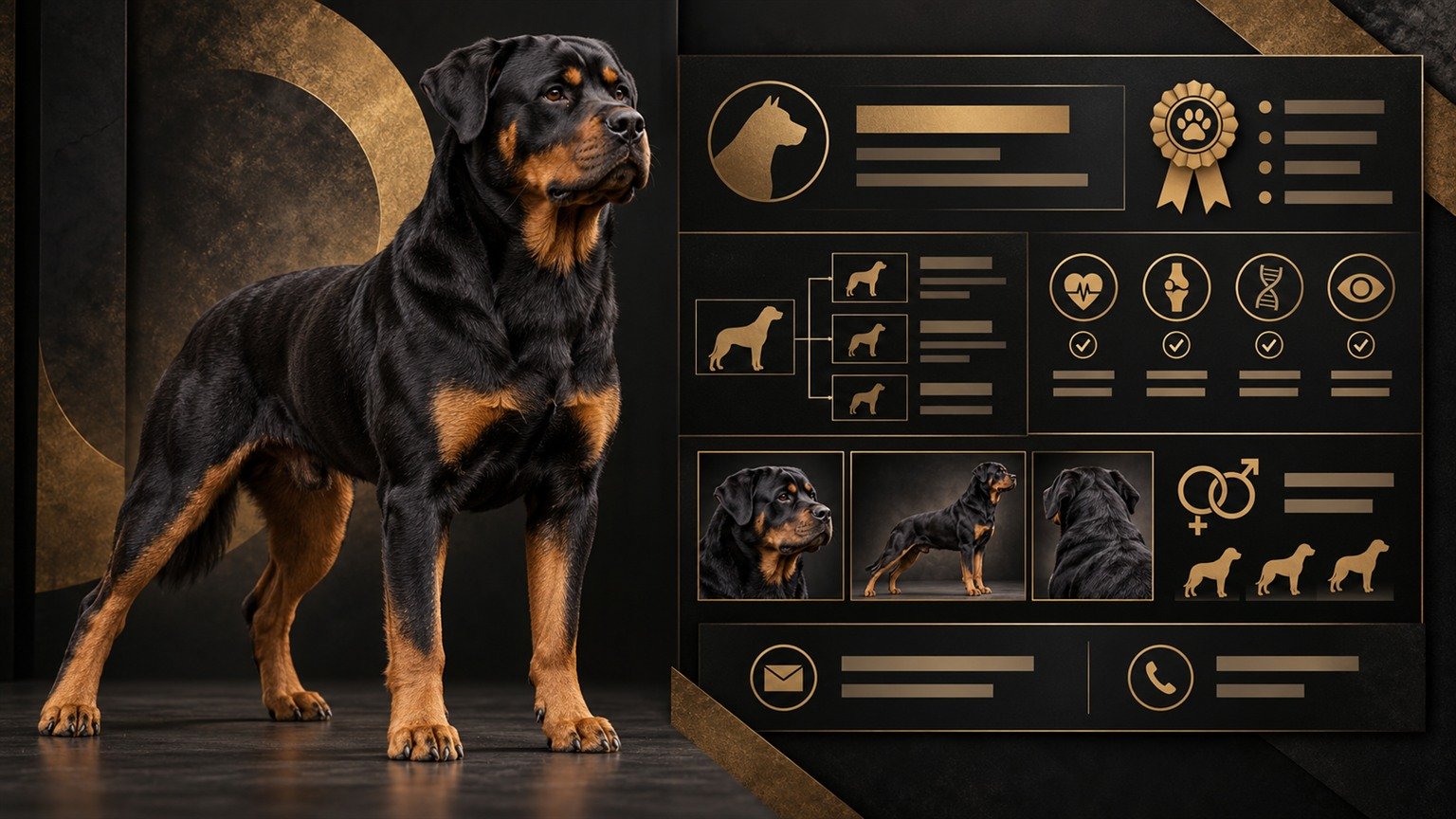
A stud dog advertisement has two jobs. It must attract attention, but it must also help another breeder understand which dog is being presented, what verified information is available and where to continue the enquiry. A striking photograph without context is incomplete; a crowded poster containing every certificate and result is difficult to use.
The strongest presentation gives essential facts a clear hierarchy. It identifies the dog, shows him accurately, summarises the most relevant pedigree, health and achievement information, and directs interested breeders to a fuller profile or a written enquiry. It does not attempt to decide whether a mating is suitable on behalf of the reader.
Quick answer
A professional stud dog advertisement should normally include the dog’s registered name, breed, a strong and accurate photograph, selected pedigree or parent information, breed-relevant health results, the most important titles or working qualifications, relevant availability details and one clear route for enquiries. The main graphic is a summary—not a substitute for the complete records a breeder needs before making a breeding decision.
1. Start With the Dog’s Identity
Begin with the dog’s registered name. This is the formal name used in registry, pedigree and show or working records, and it helps breeders connect the advertisement with the correct dog. A familiar call name can appear as supporting information, but it should not replace the registered identity.
Include the breed, especially when the advertisement may travel beyond a breed-specific group. Date of birth or current age can be useful when maturity, current results or reproductive history are relevant. Registration details may also help, but the main visual rarely needs a long registration number unless the number is genuinely useful for verification.
A practical identity line might contain: registered name, call name in quotation marks, breed and country. Keep spelling, title order and diacritics consistent with official records. This is not decorative copy: it is the foundation for checking pedigrees, results and health databases.
2. Use Strong, Accurate Photographs
The photograph is usually the first thing a viewer notices. Choose an image that represents the dog honestly and makes breed type, proportions and condition understandable. A clear full-body photograph in a natural stance is often more informative than a dramatic portrait alone. A second head study can add expression and detail where the format allows.
- Use a sharp, adequately lit original with enough resolution for the final format.
- Keep the dog clearly separated from a calm background.
- Avoid extreme angles, heavy filters or edits that change colour, markings, outline or structure.
- Choose a photograph appropriate to the claim: a movement image supports working context, while a well-positioned side view supports a structural presentation.
Graphic design can clean distractions, balance space and improve readability, but it cannot turn a blurred, badly angled photograph into reliable visual information. The practical principles in How to Photograph Puppies for Litter Announcements and Breeder Graphics also apply here: prepare the setting, work with consistent light and leave enough space around the subject for the intended layout.

3. Present Pedigree and Parentage Clearly
For breeders, pedigree information provides context that a photograph cannot. At minimum, the sire and dam can help the reader place the dog within a family. Depending on the breed and audience, selected grandparents, kennel names or a short bloodline reference may also be useful.
Do not compress a four- or five-generation pedigree into tiny type simply because the data exist. A social graphic must remain readable on a phone. If the full pedigree matters, link to a kennel website, a recognised pedigree database or a separate pedigree presentation. The article How to Read a Dog Pedigree explains why names, repeated ancestors and titles need context rather than decorative placement.
Parentage testing and pedigree information are also different things. A pedigree records declared ancestry; a parentage or identity DNA test may help verify biological relationships or identity within a particular testing system. Do not describe one as proof of the other unless the documentation genuinely supports that claim.
4. Report Health Testing Precisely
Health information deserves prominent, careful treatment. The useful tests differ between breeds and countries, so a generic badge saying “health tested” tells another breeder very little. Name the breed-relevant screening scheme or condition, give the recorded result where appropriate, and make the underlying evidence easy to verify.
- Clinical or phenotypic screening evaluates a physical trait or condition, such as hips, elbows, eyes, heart or respiratory function, using the applicable scheme.
- DNA disease testing examines specific genetic variants and may report results such as clear, carrier or affected for that particular variant.
- Parentage or identity testing supports identity or biological relationship; it is not a general health clearance.
Where a recognised public database is available, provide the dog’s searchable registered name, number or a direct profile link in the full website profile. Include dates when results can expire or when age at examination is relevant. For a concise overview of these distinctions, see Health Testing for Breeding Dogs.
Avoid unqualified phrases such as “fully health tested”, “genetically perfect” or “completely healthy”. No single panel covers every condition, and a DNA result does not replace clinical screening, family information or veterinary assessment. Health results inform selection; they do not by themselves prove that a dog is suitable for every breeding plan.
5. Select Titles, Show Results and Working Achievements
Titles and results can demonstrate achievement in conformation, work or performance, but abbreviations only help when the intended audience understands them. Use the official title exactly, and consider adding the discipline or awarding body when an international reader may not recognise the abbreviation.
Prioritise major championships, breed-relevant working qualifications and a small number of meaningful results. The main visual does not need every CAC, CACIB, class win or placement. A useful hierarchy is:
- Headline achievement: the title or qualification most relevant to the dog’s presentation.
- Supporting results: a short selection that provides context.
- Complete record: a website profile, results page or official database for readers who need detail.
An impressive title is evidence of a defined achievement under a particular system. It is not, on its own, evidence of health, temperament, genetic diversity or compatibility with a specific bitch.
6. Add Relevant Breeding and Availability Information
If the dog is genuinely available at stud, say so plainly and accurately. Country or general location can help breeders judge practical feasibility. Where relevant, the presentation may mention natural mating, fresh chilled semen or frozen semen—but only when the owner actually offers that option and can explain the arrangements in the enquiry process.
Breeding experience can be relevant, but phrase it carefully. “Proven sire” may mean different things to different readers: successful mating, a live litter, registered offspring or progeny with assessed qualities. A clearer advertisement states the verifiable fact, such as the number of previous litters, selected offspring achievements or where progeny information can be reviewed.
The advertisement does not need to publish every contractual term. Stud fee, repeat-service conditions, transport, veterinary procedures, registration requirements and responsibilities are better handled in a written enquiry and a clear stud contract. Availability should never imply automatic acceptance of every proposed mating.
7. Describe Temperament and Qualities Without Empty Claims
Temperament and everyday qualities matter, especially when a breed has a defined working purpose or when the dog lives and works in a particular environment. Present these as breeder observations and give concrete context: confident in a busy show environment, steady around familiar dogs, focused in a named sport, or sociable with people in everyday life.
Avoid claims such as “perfect temperament”, “flawless dog” or “ideal for every bitch”. They are not informative and ignore the importance of the proposed pairing, family history and environment. A short, specific description is more credible than a superlative.
Pedigrees, health results, titles and breeding records are not decorative labels. They are professional information. Good presentation makes them easier to understand without turning them into promises they cannot support.
8. Give One Clear Route for Contact and Enquiries
The final purpose of a stud dog advertisement is to begin an informed breeder-to-breeder enquiry. Include the kennel name and one primary route to further information: a website profile, business email, contact form or professional social profile. Country can be important for an international audience.
Do not crowd the design with every phone number, account and messaging app. A single clear instruction—“View the full profile” or “Send a stud enquiry”—is easier to act on. The detailed profile can then explain which information the bitch owner should provide, such as registered name, pedigree, health clearances, photographs and breeding goals.
9. What Does Not Need to Be on the Main Graphic?
A main graphic works best as a doorway to complete information. The following material usually belongs elsewhere:
- a full multi-generation pedigree in unreadably small type;
- every show result or title earned over several years;
- a long list of tests without dates, results or a verification route;
- the full history of the kennel or dog;
- dense paragraphs, excessive abbreviations or several competing calls to action;
- contract terms that require context and written agreement.
The key principle is simple: a stud dog advertisement should create a clear first impression and lead interested breeders to more complete information.
10. Social Graphic vs Full Stud Dog Profile
| Social or advertising graphic | Full website or stud dog profile |
|---|---|
| Designed to attract attention quickly | Designed to support detailed research |
| Registered name, breed and one strong image | Full identity, multiple photographs and background |
| Selected parentage, health and achievements | Pedigree, dated health results and complete title context |
| Short availability statement | Breeding history, offspring and practical enquiry details |
| One clear CTA | Supporting documents, database links and breeder notes |
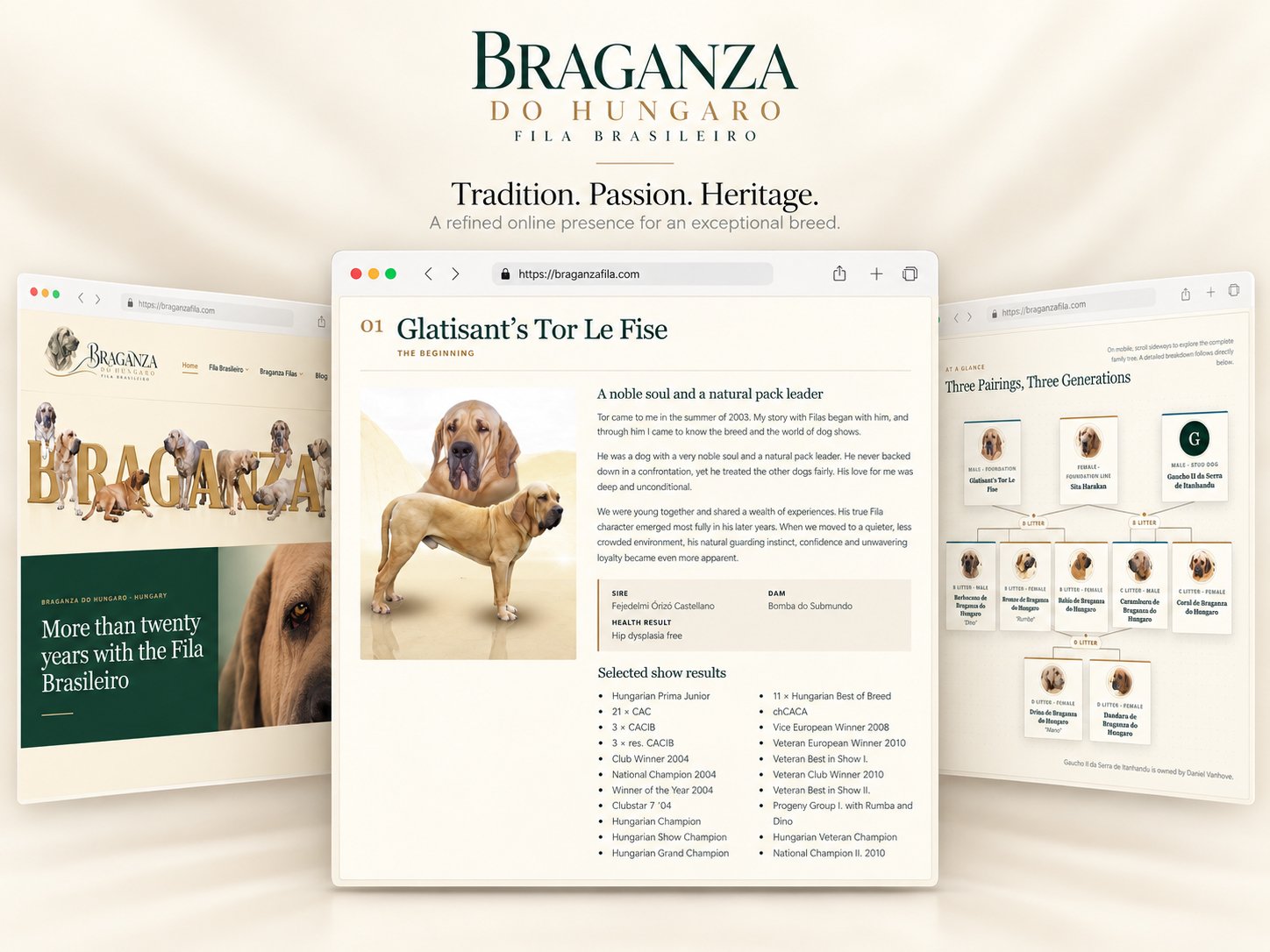
The two formats should work together. A social graphic introduces the dog; the website profile supplies the depth that responsible evaluation needs. A focused dog breeder website can keep records, photographs and updates accessible without forcing every detail into a single poster.
11. Stud Dog Advertisement Checklist
Core information
- registered name and breed;
- strong, accurate photograph;
- selected sire, dam or pedigree context;
- specific breed-relevant health information;
- most important titles or qualifications;
- kennel, country and clear enquiry route.
Useful when relevant
- age or date of birth;
- selected show or working results;
- previous litters or progeny information;
- semen availability that is genuinely offered;
- direct link to the full profile or recognised database.
Better kept off the main graphic
- full multi-generation pedigree;
- complete result history;
- long biography or kennel story;
- unexplained abbreviations and unsupported superlatives;
- detailed fees and contract clauses.
Final takeaway
A professional stud dog advertisement is not strong because every available fact fits onto one page. It is strong because it prioritises accurate information, presents it with a clear visual hierarchy and gives interested breeders a reliable next step. Design should make the dog and the evidence easier to understand—not replace the records, discussion and judgement required for responsible breeding decisions.
Need a clear, professional presentation for your stud dog?
BodArtDogs creates custom stud dog and breeding-dog presentation graphics built around photographs, pedigrees, health information, titles and the details breeders actually need to communicate. Explore Stud Dog & Dog Presentation Design →
Sources & Further Reading
- The Kennel Club: Health screening—step-by-step guide for breeders
- The Kennel Club: Guide to the content of a stud dog contract
- Orthopedic Foundation for Animals: Canine Health Information Center (CHIC) Program
- American Kennel Club: How to read and use a dog’s pedigree
- American Kennel Club: Titles and abbreviations