

A stud dog profile on a breeder website has a different job from a short social post or a one-off advertisement. It should give another breeder enough organised, verifiable information to decide whether the dog may deserve closer consideration for a planned mating. That means presenting identity, pedigree, health testing, temperament, structure, achievements, offspring and enquiry information as one coherent record—not as a collection of impressive claims.
A stud dog profile should help another breeder evaluate the dog—not just admire him.
1. Start with the purpose of the profile
A professional profile is a permanent reference page for one dog. It can support initial research, later discussion and informed comparison with other potential sires. Unlike a stud dog advertisement, which often introduces a dog in a compact format, the website profile should hold the fuller evidence behind the presentation. It should remain useful even when there is no current campaign, litter announcement or social-media post.
Think of the advertisement as an invitation to look closer and the profile as the place where that closer evaluation begins. A social graphic may highlight a small number of strengths because space and attention are limited. The website page can show the registered identity behind the call name, the individual results behind “health tested,” and the actual history behind a title or breeding claim. Keeping these roles distinct also makes future promotion easier: every short announcement can link back to one stable, maintained source instead of repeating an incomplete set of facts.
2. Make the dog’s identity unmistakable
Begin with the dog’s full registered name and the everyday name used by the kennel. Add the breed, sex, date of birth, colour or variety where relevant, registration number, breeder and owner. If the dog is owned jointly, lives in another home or is available only through frozen semen, explain that accurately. Clear identification prevents confusion between similarly named dogs and helps visitors match the page with pedigree databases, health-test records and show results.
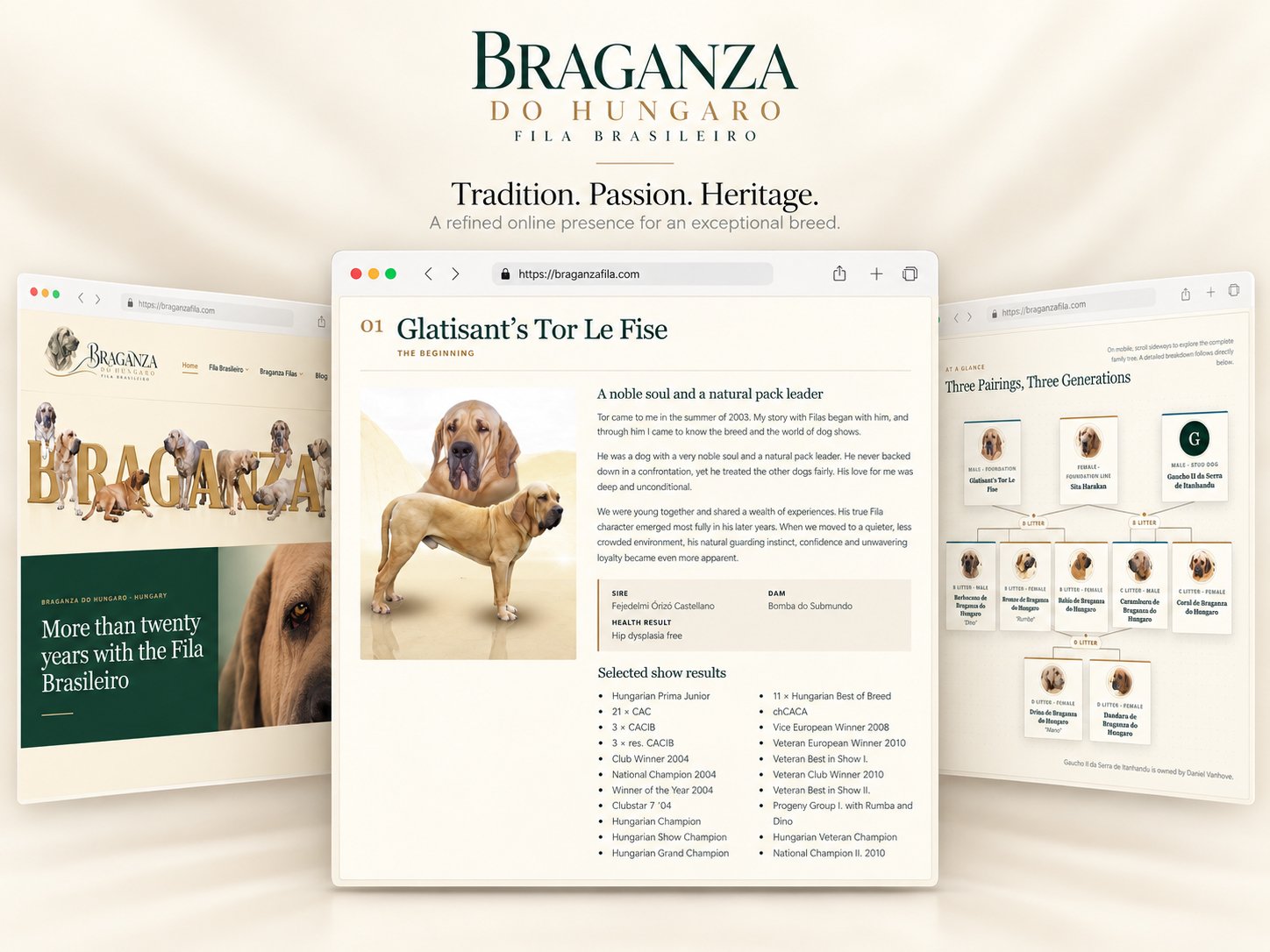
3. Use a concise summary before the detail
A short opening summary helps a breeder understand why the dog is relevant before reading a long page. Mention the dog’s age, broad type, working or show context, notable health information and the qualities for which he is best known. Keep this factual. “Confident, stable male with breed-appropriate health testing and proven working ability” is more useful than a string of superlatives that cannot be evaluated.
4. Present the pedigree as usable information
Include a readable pedigree rather than only naming famous ancestors in the body text. Three to five generations may be appropriate depending on the breed and the purpose of the page. Registered names, registry numbers and recognised titles should be reproduced accurately. A link to a trusted breed database can be helpful, but it should not replace the core pedigree on your own site. Breeders who need context can also use a guide to reading a dog pedigree.
5. Explain lineage without overselling it
Pedigree names become meaningful when you explain the breeding context: line, diversity considerations, relevant relatives, longevity patterns or traits seen consistently in the family. Avoid implying that an ancestor’s title automatically predicts the stud dog’s breeding value. A profile should separate documented facts from the owner’s interpretation and should leave room for the prospective breeder to perform an independent pedigree analysis.
6. Show health testing in a verifiable format
List each completed test with the scheme or laboratory, result and date. Where the system permits it, link to the official record or give the identifier required to find it. The Orthopedic Foundation for Animals notes that its CHIC programme uses breed-specific screening recommendations and public records; a CHIC number confirms that the required tests were completed and disclosed, not that every result was normal. That distinction is exactly why a profile should show the individual results clearly rather than relying on a badge alone.
Use the terminology printed on the certificate and identify the country or scheme when grading systems could be confused. For example, hip and elbow results may be reported through different scoring systems, and a number without its scheme can be meaningless to an international visitor. If a DNA result applies only to a particular variant, name that variant rather than presenting it as a blanket guarantee about the dog’s health.
Your page can organise health-test results on a breeder website, but it should not replace certificates or searchable records. For more background, link visitors to your explanation of health testing for breeding dogs and, where relevant, the meaning of clear, carrier and affected genetic-test results.
7. Match the health section to the breed
A generic “health tested” statement is not enough. The useful tests differ by breed, population and national scheme. Make the page easy to update when a new examination is completed or an age-dependent result changes. If the dog has a finding that requires context, state it accurately and explain how it is considered in mating decisions. Do not hide a result behind vague wording or crop it from a certificate.
8. Describe temperament with evidence and context
Temperament matters in every breed, but adjectives alone are weak evidence. Describe how the dog behaves in daily life, around unfamiliar people, with other dogs and in the environments relevant to the breed. Mention formal temperament assessments, working qualifications or sustained real-world roles when applicable. A balanced description can acknowledge both strengths and management needs without turning the profile into either criticism or promotion.
9. Document structure and movement honestly
Use recent, unaltered photographs that let another breeder see the dog rather than only an artistic crop. A standing side view, front and rear view, head study and movement image or video can be valuable. State the dog’s current age in the photographs. Editing may improve exposure or background cleanliness, but it should never change colour, markings, proportions, topline, angulation or any health- or conformation-related feature.
10. Select photographs that answer different questions
The hero image should establish identity and quality at a glance. Supporting images can show head type, outline, movement, working context and mature condition. Avoid filling the page with near-duplicate portraits. Label older images and puppy photographs so they are not mistaken for the dog’s current appearance. If semen is available from a deceased dog, make the dates and historical context clear.
11. Separate titles from results
List official titles exactly as awarded and identify the issuing organisation when the abbreviation may be unfamiliar internationally. Significant individual results can sit underneath, with date, event, class and judge where appropriate. Do not convert a placement into a title or imply that a local award is internationally recognised. Official FCI documentation, for example, distinguishes recognised international titles and pedigree information from informal descriptions.
12. Include work, sport and functional evidence
For working or performance breeds, explain what the dog actually does. Qualifications, trials, scores, hunting or herding work, service roles, endurance tests and breed-relevant assessments can all provide context. Add only information that can be described accurately. A short explanation of an unfamiliar qualification is more useful to an international reader than a dense line of abbreviations.
13. Add breeding status and reproductive information carefully
State whether the dog is proven, available at stud, available selectively, or represented by stored semen. If appropriate and supported by documentation, include semen evaluation information, collection location and shipping possibilities. Do not promise international availability before confirming the practical and veterinary requirements. Any contractual, veterinary or legal conditions should be checked for the countries involved.
14. Show offspring without turning them into proof of everything
If the dog has offspring, add representative examples with the dam, breeder, litter date and the owner’s permission. Summarise verified health results, titles or working achievements where relevant. Avoid presenting one successful puppy as a guarantee of what the sire produces. A useful offspring section shows patterns over time and makes the family context traceable.
15. State what the stud owner considers in a match
A responsible profile should make clear that availability is not automatic. Explain the information requested about a potential bitch: registered identity, pedigree, age, health results, temperament, breeding goals and relevant history. The Royal Kennel Club’s stud dog contract guidance expects health-test information for the stud and recognises the importance of reviewing the bitch’s relevant results as well. AKC breeder guidance similarly emphasises evaluation, health checks and a written agreement.
16. Give practical enquiry information
Tell breeders how to make an initial enquiry and what to include. A written form or email can collect the bitch’s registered name, pedigree link, test results, location, expected season and breeding objectives. Explain the likely response process without publishing private addresses, personal phone numbers or contract terms that should remain individual. Clear written communication helps both parties keep the scope and decisions documented.
International enquiries need a little more context. Ask for the registry and country, not only a pedigree name. If chilled or frozen semen may be considered, describe availability cautiously and confirm logistics individually with the relevant veterinary and regulatory professionals. The profile can make the first exchange efficient, but it should not try to replace a mating assessment, veterinary advice or a written stud contract.
17. Keep profile facts, promotional claims and conditions distinct
| Profile element | What to publish | What to avoid |
|---|---|---|
| Identity | Registered name, registry number, birth date, owner | Nicknames without traceable identity |
| Health | Test, result, date and verifiable record | “Fully health tested” without details |
| Pedigree | Readable generations and accurate titles | Famous names used as a substitute for analysis |
| Achievements | Official titles and clearly labelled results | Inflated or ambiguous abbreviations |
| Breeding | Availability, offspring context and enquiry process | Guaranteed outcomes or universal suitability |
18. Make the page easy to scan and update
Use meaningful headings, short paragraphs, labelled data and a consistent order across all breeding-dog profiles. Put the most decision-relevant information near the top, then provide detail and supporting evidence. Build the page so that health results, titles, images and offspring can be updated without redesigning it. A well-structured dog breeder website should make these updates practical for the kennel, not dependent on a new campaign graphic every time.
Design should support comparison rather than compete with it. Repeat the same labels and sequence for each stud dog, use tables only where they improve clarity, and keep essential facts readable without opening an image. Text embedded inside a poster is harder to update, search and read on a small screen. A polished graphic can strengthen the visual introduction, but important breeding information should also exist as accessible page content.
19. Review the profile on a regular schedule
Check the page after every new health result, title, litter or material change in availability. Test outgoing certificate and database links, verify that contact information still works and remove time-sensitive claims that are no longer true. Add a visible “last updated” note if the profile contains information that changes frequently. The goal is not constant rewriting; it is keeping a trusted reference accurate.
20. Use a final publication checklist
Essential
- Full registered identity and ownership information
- Readable pedigree with accurate names and titles
- Breed-relevant health results with dates and verification
- Current, honest photographs
- Temperament and relevant functional context
- Stud status and a clear written enquiry route
Strongly useful
- Structure and movement views
- Official show, work or sport results
- Representative offspring information
- Explanation of matching criteria
- Links to certificates, registries and trusted databases
Optional, when relevant
- Semen collection and shipping information
- Video of movement or work
- Downloadable pedigree or health summary
- Historical photographs and extended family notes
The strongest stud dog profiles combine presentation with evidence. They make the dog memorable, but they also make identity, health, pedigree, temperament, achievements and enquiry expectations easy to verify. That balance supports better breeder communication and more informed mating decisions.
Need a clearer way to present your stud dog?
BodArtDogs creates structured, breeder-specific presentations that bring photography, pedigree, health information, achievements and breeding details together in a professional visual format.
Sources and further reading
- Orthopedic Foundation for Animals: Canine Health Information Center
- Orthopedic Foundation for Animals: Interviewing a Breeder
- The Royal Kennel Club: Guide to a Stud Dog Contract
- American Kennel Club: Guide to Responsible Dog Breeding
- Federation Cynologique Internationale: Organisation and international records