
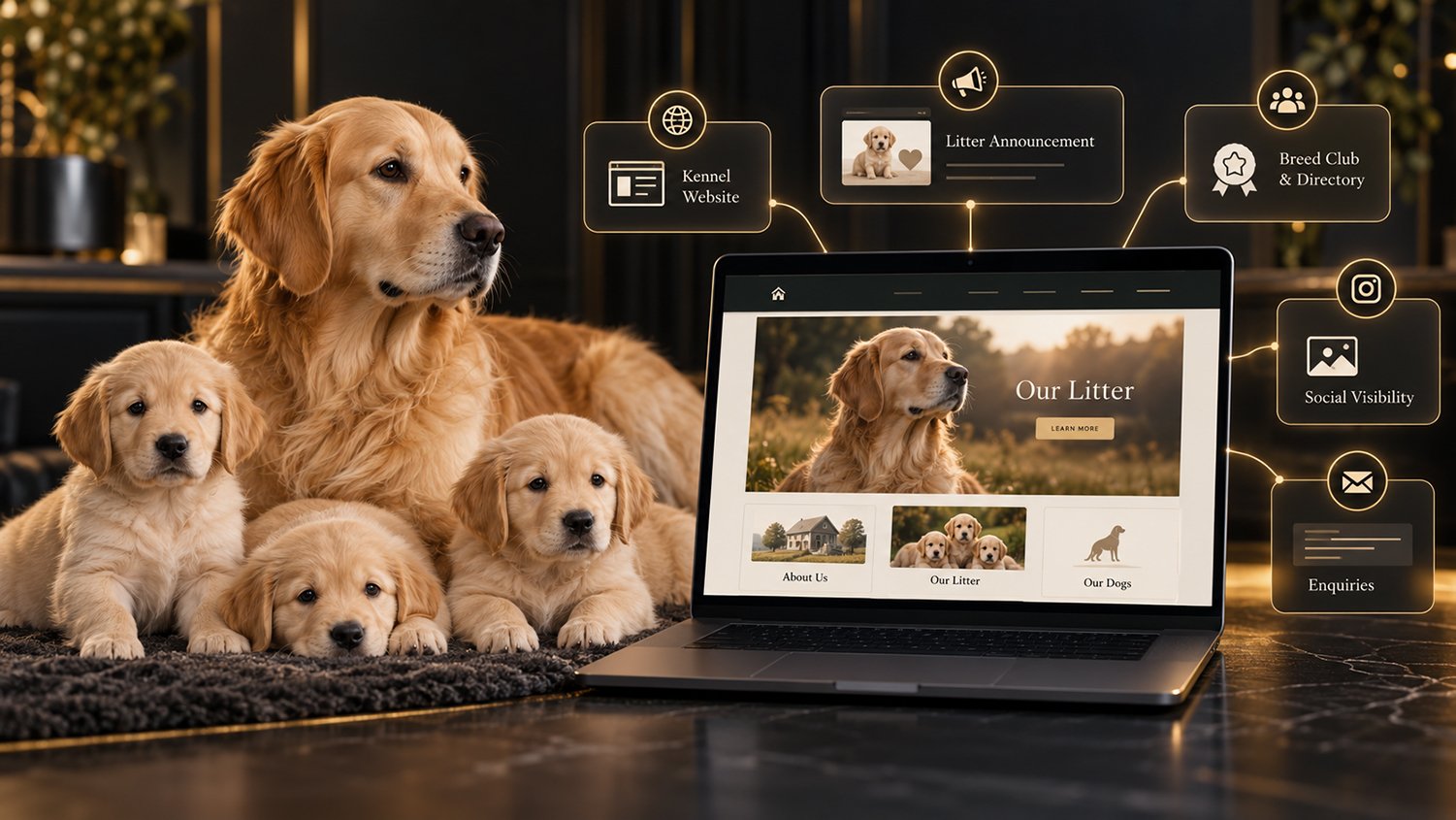
Responsible breeders do not need to promote every litter everywhere. The better question is where the right audience can find complete, current information and make a considered enquiry. That usually requires a small group of channels working together rather than one marketplace or one social platform.
This guide looks at international channel types, not a universal list of websites. Breed organisations, advertising rules and legal requirements vary by country, so breeders should confirm the current requirements that apply where they live and where their puppies may be placed.
A litter announcement presents a planned or current litter as a whole. A puppy availability notice concerns one or more individual puppies currently seeking suitable homes; a breeder directory listing is a discovery route; and paid advertising is a separate, platform-controlled activity. Breeder visibility is broader than any one of these.
Start with the kennel’s own website
A kennel website is the most stable place to explain the breeding programme in context. A litter page can introduce the sire and dam, timing, pedigree, relevant health information, photographs, puppy-raising approach and enquiry process without forcing everything into a social caption.
The website should remain useful after an individual post disappears from a feed. It can also connect the current litter to the breeder’s dogs, previous litters, health-testing information and contact form. A well-structured dog breeder website gives every other promotional channel a reliable destination.
Keep the litter status accurate. If plans change, puppies are reserved or enquiries close, update the page rather than allowing old information to circulate indefinitely.
Breed club and kennel club listings
National kennel clubs, recognised breed clubs and regional clubs may maintain breeder directories, puppy listings or litter information. These can be valuable because visitors are already looking within a breed-specific or registration-based context.
Eligibility and listing standards differ. Some organisations restrict listings to members, registered litters or breeders who meet defined requirements. Check the organisation’s current first-party guidance rather than copying another breeder’s approach. For example, The Kennel Club’s guidance on finding homes for puppies discusses preparation, advertising and meeting prospective owners in its own jurisdiction.
Comparable services are country-specific. For example, the Canadian Kennel Club’s Puppy List is available to CKC members and applies its own eligibility and listing requirements.
Responsible breeder directories
A breeder directory can help people discover kennels outside their immediate network, but inclusion alone does not establish quality. Before using one, review who operates it, what information it requires, whether profiles can be kept current and how it distinguishes breeders from high-volume sellers or anonymous listings.
- Does the directory verify identity, registration or health information?
- Can the breeder link to a full kennel or litter page?
- Are expired listings removed or clearly marked?
- Does the platform explain its standards and complaint process?
- Can enquiries be handled in a way that supports proper screening?
Use directories as discovery routes, not as substitutes for the breeder’s own information and evaluation process.
Social media
Social channels are useful for showing the ongoing life of the kennel: planning, training, shows, health information, pregnancy updates, puppy development and placements. This history gives a new visitor more context than a single availability post.
Platform rules for animal-related content and advertising can change, and features vary by country. Check the platform’s current policy before posting. Keep important details on the kennel website so the information is not dependent on one account or algorithm.
A clear planned litter announcement can introduce the pairing and direct readers to the full litter page. Consistent graphics for dog breeders can help identify the kennel while keeping names, timing and next steps readable across formats.
Referrals from trusted people
Referrals may come from previous puppy owners, other breeders, breed mentors, trainers or veterinary professionals who know the programme. They can produce well-informed enquiries, but a recommendation should still lead to the same careful information-sharing and screening process used for any other prospective home.
Make it easy for trusted contacts to share the correct link. A current litter page is more reliable than a screenshot containing an old date or availability status.
A well-managed waiting list
For some programmes, the strongest audience exists before the litter is born. A waiting list or expression-of-interest process can help breeders understand what prospective homes are looking for and communicate expected timing without promising a particular puppy too early.
Explain how the process works: whether the list is informational, when formal applications open, how updates are sent and what happens if a planned mating changes. Clear expectations protect both the breeder and the applicant from treating the list as a guaranteed reservation.
Existing breeder and owner networks
Breed communities, working or sport networks, co-owners and owners of related dogs may know homes suited to a specific litter. This route can be especially relevant when a pairing has a clear show, working or preservation purpose.
Private recommendations still benefit from public, documented information. Share a page that accurately presents the parents, relevant testing and the breeder’s goals instead of relying on a chain of forwarded messages.
Choose channels around the litter, not habit
The appropriate mix depends on the breed, the purpose of the litter, geographic reach and the breeder’s existing community. Consider:
- where informed prospective homes already look for the breed;
- whether the channel allows enough context for a responsible decision;
- how easily information and availability can be updated;
- whether the route supports a direct, documented enquiry;
- which organisation or platform rules currently apply;
- how every short announcement connects to the full kennel information.
More reach is not automatically better reach. A smaller breed-specific audience may be more valuable than thousands of impressions from people who have seen only a puppy photograph.
Present the litter consistently across channels
The facts should remain consistent even when the format changes. The website may carry the complete information, a club listing may use a standard form, and a social post may highlight only the pairing and timing. Names, dates, health claims, status and contact route should agree across all of them.
Create one source document for the litter, then adapt it deliberately. This reduces errors and makes updates easier when plans or availability change. Use photographs and graphics to support understanding, not to replace the information needed for an informed enquiry.
A responsible promotion system is connected
A practical system often begins with the kennel website, adds suitable club or directory listings, and uses social media and trusted networks to bring the right people to that information. Waiting-list communication can support the process before and after a specific litter is announced.
The goal is not to make puppies look like a fast-moving product. It is to make the breeding programme, the litter and the enquiry process clear enough for prospective homes to take the next responsible step.
Need a clearer path from discovery to enquiry?
A breeder website can act as the reliable home for litter information, while consistent breeder graphics can support the shorter announcements that lead people there.