
Quick answer
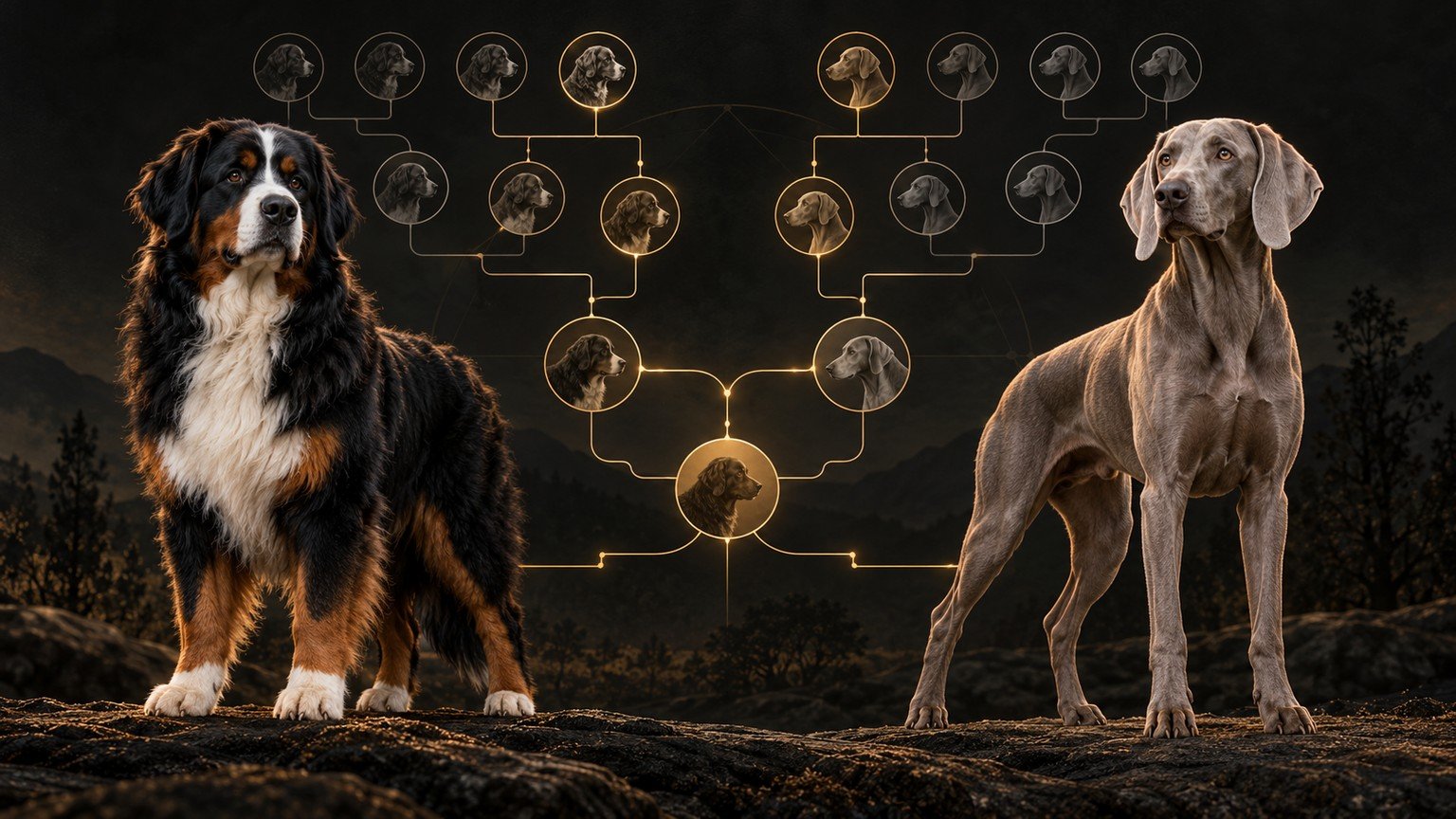
Linebreeding generally means mating related dogs with the intention of retaining the influence of particular ancestors or a family line. Inbreeding is the broader genetic term for mating related individuals. In other words, linebreeding is not a separate genetic mechanism: it is a breeder term for a planned form of related mating, often involving relatives described as less close than parent–offspring or full-sibling matings.
The terminology is not used identically by every breeder, kennel club or geneticist. What matters biologically is not the label alone, but how related the dogs actually are, which ancestors they share, how complete the pedigree is, what the coefficient of inbreeding (COI) or genomic data show, and what is known about health and diversity in the wider breed population.
Linebreeding has played a long-standing role in the development of dog breeds and kennel families. Breeders have used it in an attempt to make type or working characteristics more predictable and to retain the influence of valued dogs. The same genetic process, however, can also increase homozygosity, expose harmful recessive variants and reduce diversity. This guide explains the concepts and the questions behind them; it does not recommend a particular mating.
1. What Does Linebreeding Mean in Dogs?
In breeder terminology, linebreeding usually describes a mating between dogs that share one or more ancestors, selected so that a particular family or influential dog appears on both sides of the proposed pedigree. The aim has traditionally been to concentrate ancestry associated with valued characteristics—perhaps breed type, structure, temperament, working ability or producing consistency.
There is no universally accepted generation-based boundary at which a mating changes from “inbreeding” to “linebreeding.” Definitions vary. The American Kennel Club glossary gives a narrow breeder-style definition, while other AKC educational material describes linebreeding more broadly as mating dogs more closely related than the breed average. Population genetics does not create a separate category for the breeder’s intention: if two dogs share ancestry, their offspring may inherit alleles from common ancestors through both parents.
The useful question is not simply, “Is this called linebreeding?” It is, “How much ancestry do these dogs share, how reliable is the available information, and what could that shared ancestry mean in this breed and population?”
2. Is Linebreeding Different From Inbreeding?
In everyday breeder language, the terms often communicate different relationship patterns. “Close inbreeding” commonly refers to matings such as parent to offspring or full sibling to full sibling. “Linebreeding” is often used for more distant or strategically selected relationships built around an ancestor or family. That distinction can be useful when describing pedigrees, but it should not imply that linebreeding is genetically unrelated to inbreeding.
Both involve related individuals and can increase the probability that offspring receive two copies of alleles inherited from the same ancestral source. The degree and pattern of relatedness may differ, and that difference matters, but a more reassuring label does not remove the underlying genetics. Likewise, two matings described with the same breeder term may have very different calculated COIs, pedigree histories and population consequences.
3. Why Have Breeders Used Linebreeding?
Selective breeding works by changing the frequency of inherited variants across generations. Historically, breeders used related matings to increase the chance that descendants would inherit combinations associated with a valued ancestor or a recognisable family. Potential goals included greater consistency, maintaining breed type, preserving a working characteristic or making some outcomes more predictable.
That logic has an unavoidable second side. The process does not concentrate only the alleles a breeder can see and wants to retain. It can also concentrate recessive disease variants, variants with small or poorly understood effects, and overall genetic similarity. A respected ancestor may pass favourable characteristics, neutral variation and harmful variants through the same pedigree. Selection based only on appearance, titles or reputation cannot separate all of these possibilities.
4. What Happens Genetically?
Related dogs are more likely to carry stretches of DNA inherited from shared ancestors. Their puppies therefore have an increased chance of receiving matching ancestral copies—alleles that are identical by descent—from both parents. Across the genome, this can increase homozygosity, meaning that the two inherited copies at more locations are the same.
Homozygosity is not automatically harmful. Many alleles are neutral, and predictable traits can involve homozygous combinations. The concern is that harmful recessive variants can be hidden in healthy carriers and become expressed when a puppy inherits the same harmful variant from both sides. Greater relatedness can also reduce the range of genetic variation available within a kennel line or breed population.
Research in dogs has associated higher genomic inbreeding with some measures of reduced fitness or health, but results vary by breed, trait, dataset and method. For example, a study of Golden Retrievers found an association between higher runs-of-homozygosity-based inbreeding and smaller live litter size. That finding supports careful population-level thinking; it is not a formula that predicts the outcome of every individual mating.
5. Linebreeding and COI
The coefficient of inbreeding estimates the probability that the two alleles at a locus in an individual are identical by descent. A pedigree-based COI is calculated from recorded ancestry. Its usefulness depends on the number of generations included, the accuracy and completeness of the pedigree, and the reference population used by the calculation.
A genomic estimate examines DNA markers, often using runs of homozygosity, and may not match a pedigree estimate exactly. Recombination means that littermates do not inherit identical segments, while missing or shallow pedigree records can hide shared ancestry. The method and reference frame should therefore be stated whenever a COI is discussed.
COI is useful context, not a complete judgement of a mating. It does not identify every disease risk, describe the clinical significance of known variants, measure temperament or structure, or show how widely particular ancestors are represented across the breed. For a fuller explanation, see What Is COI in Dogs?
6. Why Pedigree Appearance Can Be Misleading
A three-generation pedigree can make a proposed mating look more or less related than it really is. An obvious repeated name deserves attention, but absence of a repeat in the visible generations does not prove that the dogs are unrelated. The same ancestors may appear further back, and a famous sire can enter both sides through several different descendants.
Pedigree depth matters because every additional generation creates more possible paths to shared ancestors. Completeness matters as well: unknown dogs, imported lines with limited records, duplicates or recording errors can affect the calculation. Repetition also needs context. One ancestor appearing twice is not interpreted in isolation from all other relationships in the pedigree.
A pedigree remains valuable—it records ancestry, shows patterns and helps breeders investigate family information—but it is a map rather than a complete genetic report. Read it together with COI methodology, health and production records, genomic information where available, and knowledge of the wider family. The guide How to Read a Dog Pedigree explains the basic structure and the difference between names, titles and meaningful family information.
7. Risks Associated With Increased Relatedness
The potential risks arise from probabilities across many genes and generations, not from a moral label attached to one pedigree. Increased relatedness can:
- increase homozygosity and the chance that recessive variants become paired;
- reduce genetic diversity within a family, kennel line or breed;
- make unknown or untested inherited problems easier to express;
- contribute to inbreeding depression, a population-genetic term for reduced fitness associated with inbreeding;
- limit future breeding options when the same ancestry becomes widespread.
Possible fitness effects discussed in canine research include litter size, fertility, neonatal survival, morbidity and immune-related diversity. Evidence is not equally strong for every trait or breed, and environment, record quality, body size and management can complicate interpretation. Responsible communication should acknowledge both the documented concern and the limits of prediction.
8. Linebreeding and Genetic Testing
A DNA panel can identify particular tested variants. It cannot certify that a related mating is genetically “safe,” because no panel covers every harmful variant, complex disease, fertility factor or diversity concern. Tests also differ in validation and relevance by breed.
For a known autosomal recessive condition, clear, carrier and affected results can guide risk management for that specific variant. They do not describe genome-wide relatedness. Removing every carrier from breeding without considering allele frequency and population size may also narrow the gene pool. The articles Clear, Carrier and Affected and Health Testing for Breeding Dogs explain why individual test results need breed-specific and population-aware interpretation.
9. Linebreeding and the Popular Sire Effect
Relatedness can accumulate even when a proposed pair does not look closely related in a short pedigree. When one successful male produces many offspring, his ancestry spreads through numerous branches of the population. Later breeders may encounter that sire repeatedly through sons, daughters and more distant descendants on both sides of a pedigree.
This is why a mating-level calculation should not replace population thinking. Reusing an influential ancestor can increase consistency within a line, while widespread repetition across the breed can reduce effective population size and future choice. Read The Popular Sire Effect in Dogs for a closer look at how disproportionate use of individual dogs can influence diversity over generations.
10. Genetic Diversity Matters Beyond One Mating
Genetic decisions operate at three connected levels. At the individual mating level, the question concerns the sire and dam, their shared ancestry and the expected litter. At the kennel-line level, repeated choices shape which families and variants remain available in that breeding programme. At the breed-population level, the collective use of sires, dams and families affects effective population size and long-term diversity.
A mating with a comparatively modest COI can still use ancestry already overrepresented in the breed. Conversely, a single numerical result cannot describe whether a rare family carries useful diversity, known disease risk or poorly documented history. Sustainable decisions require more than optimising one litter in isolation.
11. Is There a “Safe” Level of Linebreeding?
There is no universal number, generation rule or pedigree pattern that makes linebreeding safe for every breed and population. Kennel clubs and breed organisations may publish policies, limits or breed-average comparisons, but those tools answer particular management questions and may use different pedigree depths or databases.
Relevant context includes breed population size, effective population size, completeness and depth of the pedigree, genomic information, known disease variants, broader health screening, family history, diversity within the kennel and breed, and the purpose of the breeding programme. A low COI cannot guarantee healthy puppies. A higher result does not by itself prove that a specific disorder will occur. Numbers should trigger better questions, not replace professional and breed-specific judgement.
12. Questions Breeders Should Ask Before Interpreting a Pedigree
Pedigree and calculation
- How complete and accurate is the pedigree?
- How many generations are included in the COI?
- Which ancestors repeat, through how many paths, and how widely are they represented in the breed?
- Is the estimate pedigree-based or genomic, and what is the reference population?
Health and family evidence
- What is known about health, fertility, longevity and temperament in the wider family—not only the two selected dogs?
- Which breed-relevant screening and DNA tests are available?
- Are any results missing, uncertain or based on tests not validated for this population?
Population and future options
- Are the same sires or families already overrepresented?
- What diversity information is available for the breed?
- How could this decision affect the kennel’s options in later generations?
- Which breed-club, kennel-club, veterinary or genetics expertise is appropriate for interpreting the available evidence?
13. Linebreeding vs Inbreeding: Quick Comparison
| Area | Linebreeding | Inbreeding |
|---|---|---|
| Common breeder usage | Planned related mating centred on a family line or selected ancestor | Broad term for mating related individuals; often used colloquially for closer relationships |
| Genetic mechanism | Increased probability of shared ancestral alleles and homozygosity | The same underlying mechanism |
| Relationship pattern | Often described as more distant or strategically selected | Includes the full range of related matings, including close relatives |
| Intended purpose | Often used to retain influence, type or predictability | Intent varies; the genetic term does not specify a breeding goal |
| Risk interpretation | Depends on actual relatedness, pedigree depth, health information and population context | Depends on the same evidence; the label alone does not quantify risk |
14. Practical Takeaway
Linebreeding is not genetically separate from inbreeding. The meaningful assessment goes beyond what a mating is called. Breeders need to consider how related the dogs are, which common ancestors and family information sit behind the pedigree, how COI or genomic data were calculated, which health risks are known or unknown, and how the decision fits the genetic diversity of the kennel line and the breed population.
No single test, number or visible pedigree pattern can answer all of those questions. Clear records, honest health communication, appropriate expert input and long-term population awareness provide a stronger basis than terminology alone.
Sources & Further Reading
- The Royal Kennel Club: Avoiding Inbreeding
- The Royal Kennel Club: Health Screening for Dog Breeders
- FCI: International Breeding Strategies
- Wade CM. Inbreeding and Genetic Diversity in Dogs: Results From DNA Analysis
- Chu et al. Inbreeding Depression Causes Reduced Fecundity in Golden Retrievers
- Mooney et al. The Impact of Identity by Descent on Fitness and Disease in Dogs
- American Kennel Club: Glossary
- American Kennel Club: Breeding With Vision and Purpose