
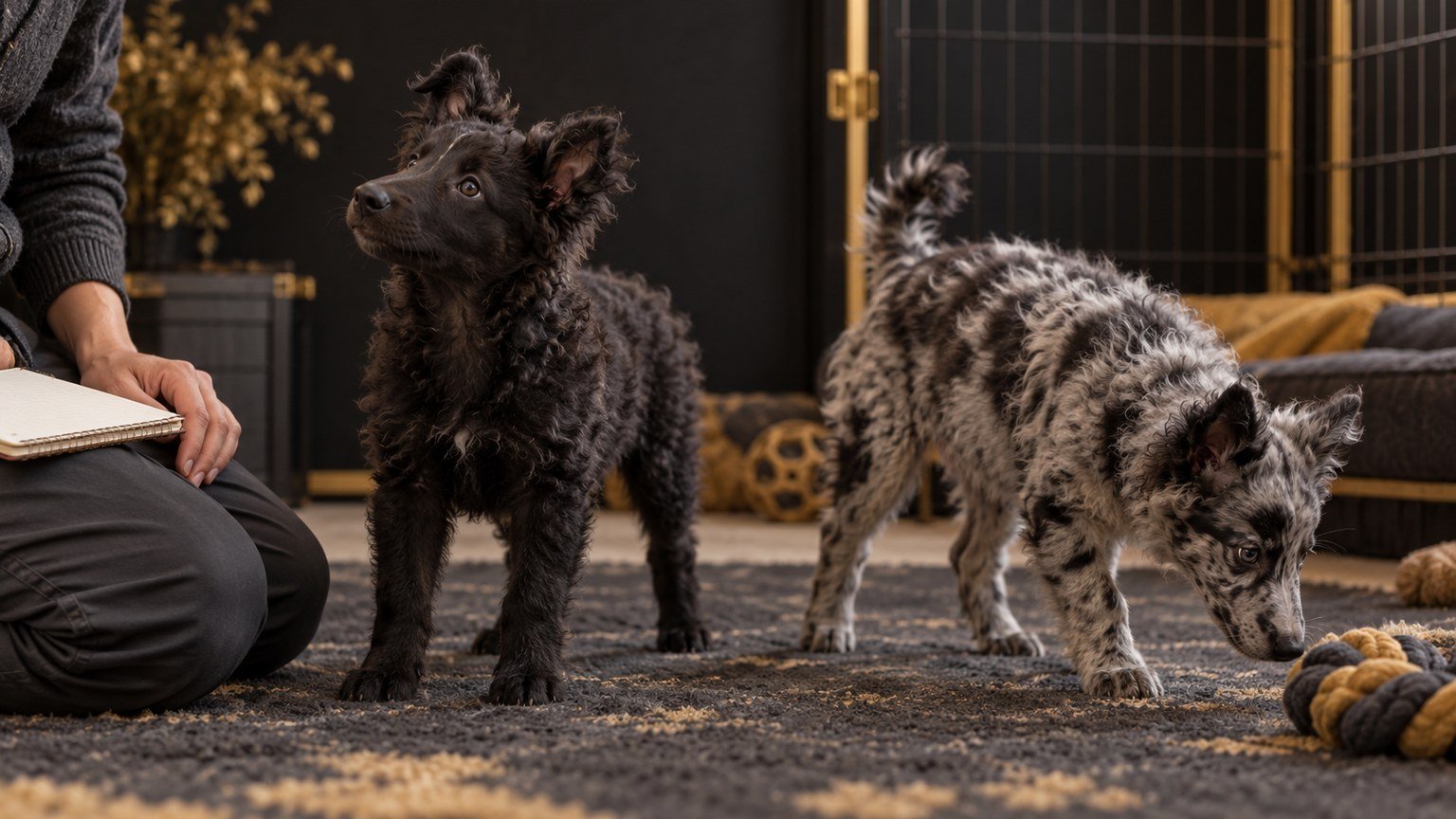
Matching puppies with owners is not about identifying a “perfect” puppy or predicting an adult dog with certainty. It is a practical decision-making process: the breeder combines repeated observations of each puppy, knowledge of the litter and breed, and detailed information about each prospective home.
The aim is a better-informed match, not a guarantee. Puppies continue to develop after they leave the litter. Their environment, learning history, health, social experiences and relationship with their new owners will all influence the dogs they become.
What puppy matching means
Puppy matching means looking at both sides of the placement. On one side is an individual puppy with developing patterns of activity, confidence, sensitivity, recovery and social interaction. On the other is a household with its own rhythm, experience, expectations and practical limits.
A responsible breeder asks whether the puppy and home are likely to support each other. That is different from allowing a family to choose from a photograph, assigning puppies only by deposit order or assuming that the most outgoing puppy is automatically the best choice.
Matching also begins before individual puppies are allocated. Clear communication about the parents, expected breed traits and the breeder’s programme helps prospective owners decide whether the litter itself may be suitable. A planned litter announcement can explain the planned pairing and intended direction without promising that a particular puppy will fit a particular home before the litter can be observed.
Do not match a puppy from one impression
A visitor may meet a puppy when it is tired, hungry, newly awake, overstimulated or simply having an unusual few minutes. One puppy may rush forward because it has just rested; another may hang back because it has already spent time exploring. A single encounter can be useful, but it is not a complete temperament profile.
The breeder has a different advantage: repeated observation. Living with the litter makes it possible to compare behaviour across days, situations and stages of development. The useful question is not “What label fits this puppy?” but “Which patterns appear repeatedly, and in what context?”
Observe the litter over time
Short notes are often more valuable than dramatic tests. Breeders can record how puppies approach new but safe objects, respond to ordinary household activity, recover after a mild surprise, engage with people, settle after play and navigate small frustrations appropriate to their age.
Observation should remain gentle and welfare-led. There is no need to frighten, restrain, hurt or provoke a puppy to produce a reaction. Useful situations are brief, safe, age-appropriate and easy to stop. The goal is to learn from normal behaviour, not to force a performance.
Several dimensions may be worth recording:
- Activity: how readily the puppy moves, plays and re-engages, and how easily it settles afterwards.
- Confidence: whether the puppy approaches unfamiliar but safe situations and how much support it seeks.
- Recovery: how quickly the puppy returns to normal behaviour after a mild, everyday surprise.
- Curiosity and sensitivity: how the puppy investigates novelty and how strongly it responds to sound, movement, touch or environmental change.
- Social interaction: how the puppy engages with familiar people, unfamiliar people, littermates and other appropriate animals.
These observations are descriptive, not diagnoses. “Needed more time before approaching” is more useful than “shy”. “Returned to play within a minute” is more useful than “brave”. Describing what happened preserves context and reduces the temptation to turn a developing puppy into a fixed personality type.
Consider activity, arousal and the ability to settle
High activity is not automatically drive, confidence or suitability for sport. A puppy can be busy because it is curious, tired, overstimulated or struggling to regulate arousal. Likewise, a quiet puppy may be relaxed, cautious, sleepy or temporarily disengaged.
Look at the whole sequence. What happens before the behaviour? Can the puppy pause, take food, respond to gentle guidance or settle after interaction? Does the same pattern appear in more than one context? For many homes, the ability to recover and settle matters just as much as enthusiasm.
Observe handling and human interaction carefully
Routine handling can provide useful information when it reflects normal puppy care. Notice the puppy’s response to being gently touched, lifted briefly, groomed or examined in a familiar way. Respect signs that the puppy needs a pause. Forced restraint is not necessary for matching and can replace useful observation with a stress response.
Human interaction should also be observed across different people and moments. A puppy that is highly engaged with its breeder may respond differently to a visitor. That difference is information, but it should be interpreted alongside age, familiarity, previous experience and the immediate environment.
Understand the prospective home
Good matching depends on more than asking whether someone has a garden or has owned a dog before. The breeder needs a realistic picture of daily life. The American Kennel Club’s breeder guidance similarly emphasises questions about lifestyle, household and expectations when placing puppies.
Topics worth discussing in writing include:
- normal household activity and the amount of quiet time available;
- children, their ages and how interactions will be supervised;
- other dogs, cats or animals in the home;
- work, travel and the time the puppy may spend alone;
- the physical environment and opportunities for safe exercise and enrichment;
- previous dog and breed experience;
- grooming, training and time commitments;
- family-companion, show, sport or working expectations; and
- what ongoing breeder support the new owner expects.
These questions are not a universal legal test of whether somebody is “fit” to own a dog. They help the breeder identify practical compatibility, clarify expectations and recognise when the current litter may not offer an appropriate match.
Match lifestyle, expectations and experience
The same puppy may be a realistic option for several different homes, and more than one puppy may suit the same family. Matching is rarely a one-to-one calculation. The task is to identify likely areas of compatibility and potential pressure points.
A highly active household is not automatically the right home for the busiest puppy. The family may want a dog that can join activities but also settle while adults work. A first-time owner is not automatically unsuitable for a sensitive or energetic puppy, but the available support, expectations and willingness to learn become especially important.
For show, sport or working homes, breeders may also consider structure, motivation, environmental confidence and breed-relevant qualities. Those goals should still be balanced against everyday life. Most performance dogs spend far more time living as household companions than competing.
Use breed purpose without relying on stereotypes
Breed history, typical activity range, coat care, maturity and original function provide useful context. Lines within a breed may also differ because breeders have selected for different work, sport, show or companion qualities.
Breed expectations do not remove individual variation. Puppies from the same litter can differ, and their behaviour continues to develop. A stereotype such as “all puppies of this breed are easy with children” or “every puppy from working lines needs a sport home” is not a substitute for observing the individual and understanding the actual household.
What temperament tests can and cannot tell you
A structured temperament assessment can add one carefully controlled snapshot to the breeder’s records. It may help different puppies encounter the same safe, age-appropriate situations and make observations easier to compare. It should not be treated as a diagnosis, a fixed personality certificate or a guarantee of adult behaviour.
Research supports this caution. A longitudinal study on the predictive value of early behavioural assessments in pet dogs found that early tests were not reliable predictors of individual adult behaviour traits. A later study of a seven-week puppy test also noted limited predictive validity and substantial variation in methods. Tests developed for a specific working outcome may be useful within that validated programme, but their results should not be generalised to every breed, household or trait.
Development also continues through experience. The American Veterinary Society of Animal Behavior’s puppy socialisation guidance stresses safe, positive exposure during early development and warns against overwhelming puppies. This is one reason matching should combine current observations with honest uncertainty about the future.
Avoid labels without context
Words such as “dominant”, “best”, “easiest”, “alpha”, “soft” or “hard” can sound decisive while hiding what the breeder actually observed. They can also encourage buyers to treat a young puppy’s behaviour as permanent.
Replace labels with examples. Instead of “the dominant puppy”, record that the puppy often initiates play, persists when access to a toy is blocked and takes longer to settle after excitement. Instead of “the easiest puppy”, explain that the puppy currently adapts quickly to routine handling and rests readily after play. Context makes the information usable.
Communicate uncertainty honestly
A responsible recommendation can still be confident without pretending to be certain. Explain why a puppy appears compatible with a home, what remains unknown and what support may help after handover. If two puppies could both fit, say so. If none appears appropriate, postponing placement can be more responsible than forcing a match.
The ASPCA’s responsible-breeding criteria also frame good placement around sharing the needs of the specific dog and understanding the prospective owner’s expectations. Clear communication protects both sides from unrealistic promises.
Document observations and follow up
A simple observation record can include dates, contexts and short behavioural descriptions. Pair it with the prospective owner’s written questionnaire and the breeder’s reasons for the recommendation. This creates a clearer handover than relying on memory or informal labels.
After placement, invite useful updates and be willing to reassess guidance as the puppy develops. The handover material can include current routine, care information and breeder contact details; see What Should Breeders Include in a Puppy Pack? for a practical structure. Health records and behaviour observations should remain distinct, while relevant parental screening can be explained through resources such as Health Testing for Breeding Dogs.
Final puppy-matching checklist
- Observe each puppy repeatedly and in more than one normal context.
- Use descriptive notes instead of fixed personality labels.
- Keep all observation activities safe, brief, gentle and age-appropriate.
- Consider activity, recovery, sensitivity, curiosity, social interaction and the ability to settle.
- Understand the household’s routine, experience, environment and expectations.
- Use breed purpose and family-line knowledge as context, not as a substitute for individual observation.
- Treat temperament tests as limited evidence, not a prediction certificate.
- Explain uncertainty and the reasons behind the recommendation.
- Document the decision and offer realistic follow-up support.
The strongest puppy match is not the one based on the boldest claim. It is the one supported by careful observation, honest information about the home, knowledge of the litter and breed, and realistic expectations about development after handover.
Need a clearer way to present puppies and practical breeder information to prospective homes? Explore Dog Breeder Graphics and Dog Breeder Website Design, or send a project enquiry.