
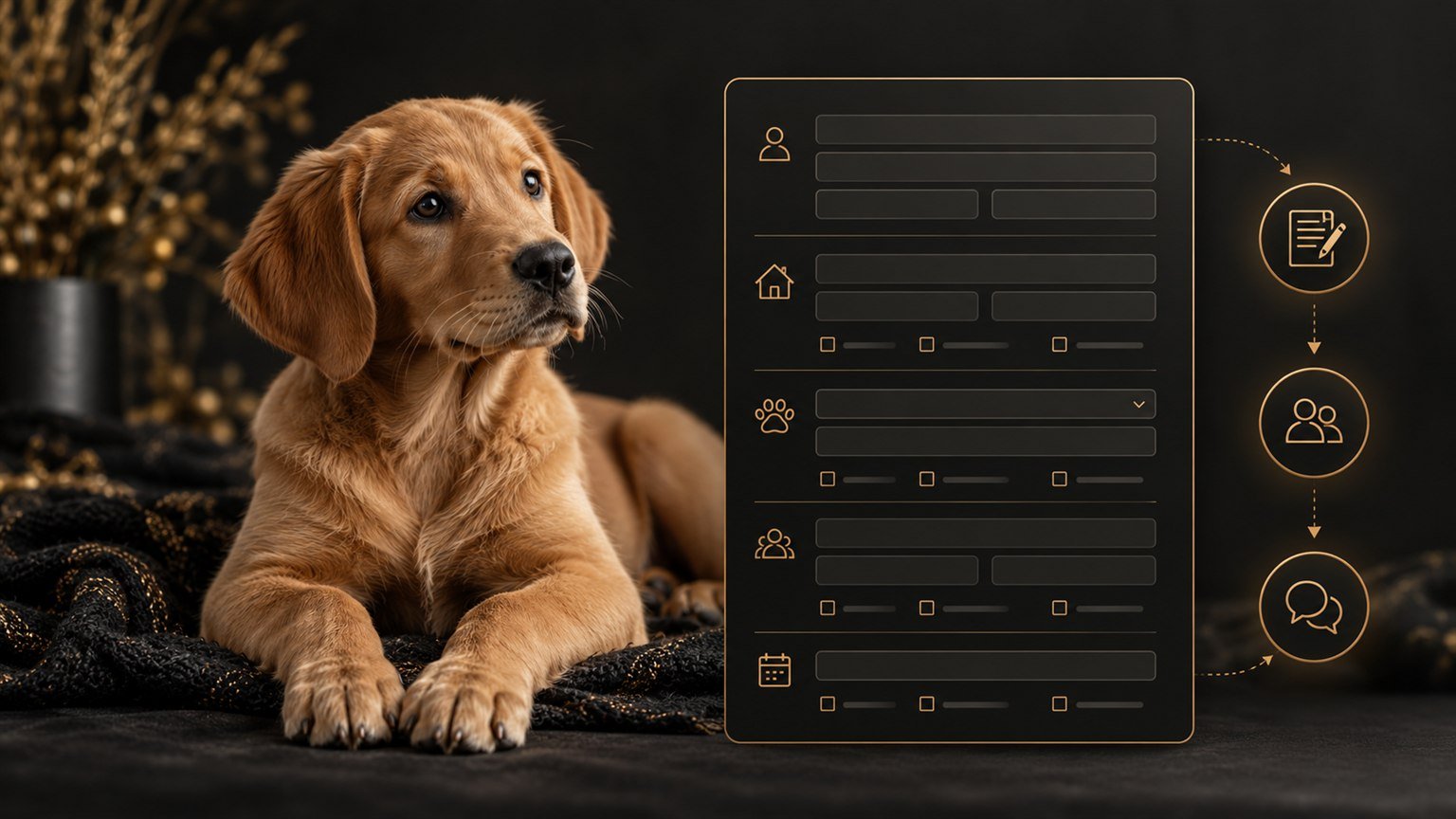
A puppy enquiry form should help a breeder understand who is making contact, what kind of home they can offer and whether a meaningful conversation is worth continuing. It should not try to make the final placement decision on its own. The most useful forms are clear, proportionate and easy to complete: they collect enough information for a thoughtful first response without turning an initial enquiry into an interrogation.
Key takeaway
Treat the form as the beginning of a breeder–owner conversation. Ask what you genuinely need at this stage, explain why the information matters and leave space for the person behind the answers.
Useful first contact, not an interrogation. A form should prepare the next conversation, not try to approve or reject a home from a single set of answers.
1. Start with the purpose of the enquiry
Begin by asking what the person is contacting you about. They may be interested in a current litter, a future litter, an adult dog, a show or working prospect, or simply learning more about your breeding programme. A short multiple-choice question can route the enquiry without forcing every visitor through irrelevant fields.
This first answer also sets expectations. Someone asking about a litter that has not yet been planned needs a different response from someone enquiring about an available puppy. Conditional form logic can reveal only the questions that apply to that route.
2. Collect practical contact details
For a first enquiry, a name, email address and country or broad location are usually enough. A phone number can be optional if your process is primarily written. Avoid collecting a full postal address, identity documents or other sensitive details before there is a clear reason to need them.
Use plain labels and state how you normally reply. A short note such as “Project and puppy communication is primarily handled in writing” can reduce uncertainty while keeping the process accessible to international homes.
3. Ask why this breed appeals to them
An open question about breed choice is more informative than a quiz. It shows what the prospective owner values, how much research they have already done and which expectations may need discussion. Their answer may focus on temperament, working ability, appearance, family experience or a previous dog.
Do not expect specialist vocabulary. A thoughtful beginner can be a stronger home than someone who knows the correct phrases but has not considered the breed’s daily needs.
4. Learn about previous dog experience
Ask whether they have owned dogs before, which breeds or types, and what happened to those dogs. This is useful context, but experience should not become an automatic gate. First-time owners may be excellent candidates when they are realistic, willing to learn and supported by an appropriate breeder.
If your breed has demanding grooming, guarding, working or training traits, add one focused follow-up. Ask how they understand that particular need rather than requesting a generic essay about dog ownership.
5. Understand the household
Useful household questions include the number of adults, children and other regular residents, plus whether everyone agrees with the plan to bring home a puppy. If children are present, a broad age range is normally more relevant than names or dates of birth.
Phrase this neutrally. The purpose is to understand the environment and prepare a suitable conversation, not to imply that one family structure is automatically better than another.
6. Ask about other animals
Ask what animals currently live in the home, including their species, age, sex and general temperament where relevant. This can flag practical questions about introductions, prey drive, same-sex compatibility or an elderly resident dog.
The form should identify topics for discussion, not promise compatibility. Actual placement decisions need the breeder’s knowledge of the litter, the individual puppy and the receiving household.
7. Describe the living environment without using crude filters
Ask whether the home is a house, apartment or another arrangement, whether there is secure outdoor access and whether there are restrictions that could affect dog ownership. Avoid treating an apartment or the absence of a large garden as an automatic rejection. Daily routine, exercise, management and commitment often provide more useful context.
If housing permission matters, ask whether the applicant is permitted to keep a dog rather than requesting tenancy documents at first contact.
8. Explore the normal weekly routine
Ask what a normal weekday looks like, who will provide day-to-day care and how long the dog may usually be left alone. This gives a more realistic picture than asking whether someone “has enough time.” It also opens a practical discussion about puppy toilet training, supervision, rest and gradual alone-time training.
Keep the question flexible for shift workers, home workers, retired people and households with changing schedules. What matters is the care plan, not whether the applicant fits a conventional timetable.
9. Ask about exercise, training and enrichment plans
A good form asks what the prospective owner expects to do with the dog: everyday companionship, training classes, showing, sport, working activity or another purpose. It can also ask how they plan to provide appropriate exercise and mental enrichment as the puppy grows.
Avoid requiring a finished training plan from someone who has not yet met the litter. You are looking for realistic intentions and willingness to learn, not polished answers.
10. Clarify the hoped-for role of the dog
Ask what kind of relationship and activities the applicant hopes to have with the dog. If your programme may place show, working or breeding prospects, let them indicate interest—but make clear that an initial preference is not a guarantee.
This is where the enquiry form hands over to the later matching process. The form gathers context; the breeder’s observations and ongoing conversation support the eventual decision. For that next stage, see How Breeders Match Puppies With the Right Homes.
Breeding intentions need a clear follow-up
If a prospective home is interested in breeding, showing or co-ownership, allow them to say so honestly. That answer should open a more detailed conversation about the breeder’s programme, health priorities, experience and future expectations. It should not turn the first form into a contract or suggest that breeding rights are already agreed.
11. Include a realistic timing question
Ask when the person hopes to welcome a puppy and whether that timing is flexible. This helps distinguish a considered future plan from a request driven by an immediate deadline. It can also reveal upcoming moves, travel, major family changes or other circumstances worth discussing.
Do not imply that a form submission reserves a puppy. State clearly that availability, suitability and placement are discussed separately.
12. Ask about preferences carefully
Colour, sex and other preferences can be recorded without making them the centre of the enquiry. Ask which preferences are essential and which are flexible. If health, temperament and fit take priority in your programme, explain that plainly.
This wording helps the breeder understand expectations while avoiding a shopping-cart experience. It also makes space for a constructive reply when the requested combination is unlikely or unavailable.
Keep financial questions proportionate
A first enquiry form should not request salary, income, bank information or detailed financial history. Breeders can communicate the puppy price, deposit policy and realistic care costs on an appropriate information page or during the next stage. The relevant question is whether expectations are clear—not whether the applicant is willing to disclose private financial data.
13. Give applicants space to ask their own questions
A strong enquiry process is two-way. Include a generous text field for questions about health testing, pedigree, temperament, how puppies are raised, contracts, support and anything else that matters to the prospective home.
The questions applicants ask can be as informative as the answers they give. They may also show where your website needs clearer information. A well-structured breeder site should explain the programme and process before the form; see What Should a Dog Breeder Website Include?.
14. Separate essential questions from useful context
Not every useful detail needs to be required. Too many mandatory fields increase friction and can encourage rushed, low-quality answers. A simple three-stage model keeps the first contact proportionate.
| Ask at first contact | Useful but optional | Better discussed later |
|---|---|---|
| Name and email | Broad location | Full address or formal documents |
| Reason for enquiry | Previous dog experience | Detailed placement or contract decisions |
| Household and routine | Preferences and planned activities | Final puppy selection |
| Other animals | Questions for the breeder | Sensitive personal or financial information |
15. Use conditional logic to shorten the form
Conditional logic shows a follow-up only when a previous answer makes it relevant. Someone interested in showing might see a question about experience and mentoring; someone seeking a family companion does not need it. An applicant with resident dogs might see a short compatibility question, while others move on.
This reduces visual length without removing useful context. It also makes a custom enquiry form feel designed around a real breeding programme rather than copied from a generic template.
16. Write questions that invite honest answers
Questions should be neutral, specific and easy to understand. “How long would the dog usually be alone on a normal weekday?” is more useful than “You will not leave the puppy alone all day, will you?” The second wording reveals the preferred answer and discourages honesty.
Avoid trick questions, moralising language and unexplained breeder jargon. If a question could be sensitive, briefly explain why you ask it. Respectful wording supports better information and a better first impression.
17. Make the form usable on a phone
Many prospective owners will first find a breeder through social media and open the website on a phone. Use a single-column form, large tap targets, clear field labels and short groups of questions. Avoid wide tables, tiny consent text and long dropdown lists that are difficult to scan.
Do not rely on placeholder text as the only label, because it disappears when typing. Show errors beside the relevant field and preserve completed answers if validation fails. Mobile usability is part of the enquiry experience, not a cosmetic extra.
18. Be transparent about data and consent
Collect only information that is genuinely relevant to handling the enquiry. Link to a clear privacy notice and distinguish necessary contact consent from optional marketing consent. Do not preselect optional consent boxes or add people to a mailing list merely because they asked about a puppy.
Data-protection rules vary by location, so obtain appropriate professional guidance for your jurisdiction. The practical principle is universal: explain what you collect, why you need it and what will happen next.
What not to ask on the first form
Avoid exact salary, identity documents, unnecessary dates of birth, highly detailed family information, references before they are needed and invasive questions with no clear connection to the placement process. Long compulsory essays also create friction without guaranteeing thoughtful answers. Ask only what helps you understand the enquiry and plan the next conversation.
19. Confirm the submission and explain the next step
After submission, show a clear confirmation page and send a short email copy where appropriate. Say whether the enquiry was received, the typical response time and whether every submission receives a personal reply. If you use a waiting list or a later questionnaire, explain that sequence.
Do not leave applicants wondering whether the form worked. Equally, avoid automated language that sounds like approval or a puppy reservation. A good confirmation acknowledges contact and sets a realistic next step.
20. Review the form as your programme changes
Test the form yourself on desktop and mobile, and review the quality of the enquiries it produces. Remove questions that never influence a reply. Rewrite fields that are frequently misunderstood. Add a question only when it solves a recurring communication problem.
The form should also align with the information elsewhere on the website, from planned litters to the support owners receive after collection. A clear puppy pack and owner resources can answer later-stage questions without overloading the first enquiry.
Puppy enquiry form checklist
- Core: name, email, broad location, purpose of the enquiry, basic household context, dog experience and what kind of home or activity the person is seeking.
- Helpful: daily routine, other animals, children where relevant, likely timing, breed experience and flexible preferences.
- Better later: detailed references, contract decisions, full placement assessment, sensitive personal data and final puppy matching.
A useful first contact, not an interrogation
The best puppy enquiry form gives a breeder enough context to respond thoughtfully while leaving room for a real conversation. It should support responsible decisions, not pretend to automate them. Keep it focused, respectful and easy to use, then move detailed matching and placement questions into the appropriate next stage.
Need a breeder website with a clear enquiry process?
BodArtDogs creates custom WordPress websites for dog breeders and kennels, including breeder-focused contact and enquiry structures built around real kennel communication.