
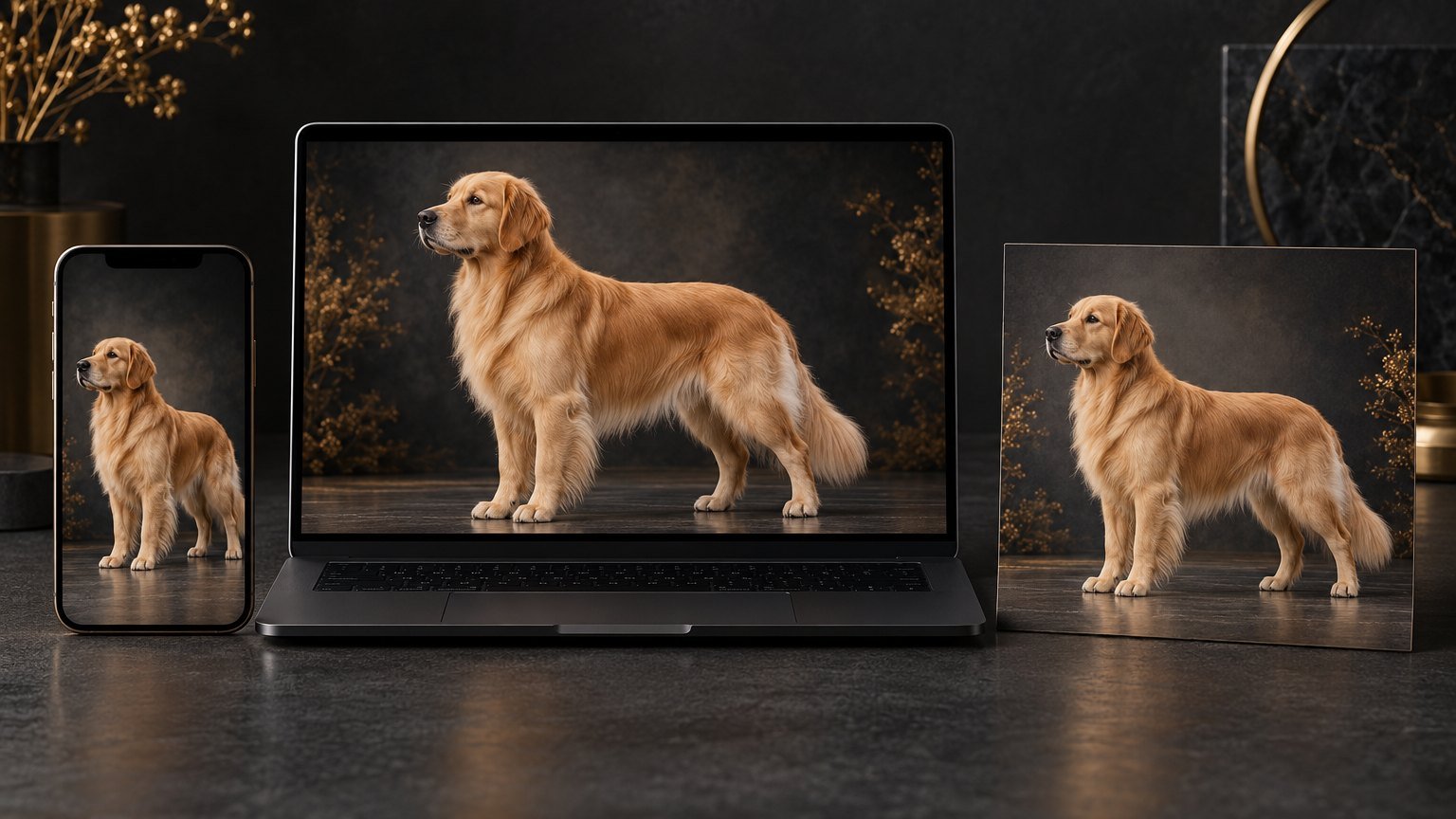
A well-designed breeder graphic should not disappear after a single social media post. The same core material can support a litter announcement, an individual puppy presentation, a stud dog campaign, a kennel website update and selected print pieces—provided that each version is adapted to its setting.
This guide explains how to use breeder graphics across different channels without forcing one file to do every job. The aim is a clear, consistent presentation that helps people understand your dogs, your breeding plans and the information behind them.
Start with one accurate master set of information
Before adapting a design, prepare the facts that must remain consistent everywhere. Depending on the purpose, this may include the dogs’ registered names, kennel names, sire and dam, health-test results, titles, planned or actual dates, puppy availability and a reliable contact route.
Check spelling, title order, health terminology and pedigree details before the graphic is finalised. A visually polished announcement cannot compensate for inaccurate or ambiguous breeding information. It is also easier to create several correct versions from one approved source than to repair different mistakes across multiple channels.
- Use high-resolution photographs with permission for the intended use.
- Keep a plain-text copy of all names, titles and test results.
- Decide which information is essential and which can live on a linked page.
- Confirm whether the piece is a litter announcement, a puppy advertisement, a stud dog advertisement or a general dog presentation.
These are related formats, but they are not interchangeable. A litter announcement presents a planned or current litter as a whole. A puppy advertisement focuses on one or more individual puppies currently available. A stud dog advertisement normally highlights one male, his pedigree, health testing, titles and relevant breeding information. A dog presentation may have no immediate sales purpose at all.
Adapt breeder graphics for social media
Social feeds are fast and often viewed on a phone. The first version should therefore be readable at a small size, with a clear focal point and restrained text. The dogs’ photographs, the type of announcement and the most important names or date should be understandable before someone opens the caption.
Do not shrink a detailed print advertisement and assume it will work as a feed post. Create a social version with fewer words, larger type and sufficient contrast. Put supporting details in the caption or direct people to a full page on your kennel website. If you also use stories, prepare a vertical crop or layout rather than leaving important dogs, names or logos outside the visible area.
Useful social variations
- Announcement post: the clearest overview of the litter, pairing or featured dog.
- Story version: a vertical layout with fewer details and a direct next step.
- Individual puppy card: one puppy, a consistent portrait treatment and only the information relevant to that puppy.
- Progress update: a repeatable format for weekly photographs, names, ages or milestones.
- Result graphic: a focused update for a show, working or health-testing result.
Consistency does not mean posting the same image repeatedly. It means that colours, typography, logo placement, tone and information hierarchy feel connected. A simple family of layouts is usually more useful than a single crowded template.
Use your kennel website as the complete reference
Your website can carry the depth that a social graphic cannot. A litter page can explain the purpose of the pairing, present both parents, link to pedigrees and health information, show photographs and outline how enquiries are handled. The graphic then becomes an entry point rather than the only source of information.
On a website, do not upload a poster as the only way to communicate important facts. Text inside an image is difficult to search, translate, copy and read with assistive technology. Keep the essential information in normal page text as well, and use the graphic to strengthen the visual presentation.
Choose the location according to the material. A current litter announcement may belong on the homepage and a dedicated litter page. A breeding dog presentation fits naturally on that dog’s profile. A stud dog graphic can support a detailed stud page, while past litter and show-result graphics may belong in an archive or news section.
If your website needs a clearer structure for dogs, litters and breeder information, see Dog Breeder Website Design. For the wider content system behind these updates, read Dog Breeder Marketing: A Practical Content System for Kennels.
Prepare separate files for print
A social media image is not automatically print-ready. Printed materials may require a different size, resolution, colour setup, margin and bleed. Ask the printer for specifications before the design is exported, especially for magazine advertisements, flyers, stud cards, posters or exhibition materials.
Print also changes how much information is practical. A magazine advertisement can include more detail than a phone-sized post, but it still needs a clear reading order. A small card should not become a miniature pedigree database. Use a short URL or QR code when it genuinely helps readers reach an up-to-date page, and always test it before printing.
Use email graphics as support, not as the whole message
A litter announcement or dog presentation can make an email more engaging, but the key information should also appear as text. Some recipients block images, and a large attachment can be slow or inconvenient. Use a web-optimised version, add meaningful alternative text and link to the relevant page for full details.
For waiting-list updates, the graphic can introduce the news while the email explains what has changed, what information is available and what the recipient should do next. This keeps the communication useful even when the image is not displayed.
Keep one visual identity while changing the format
A kennel’s graphics feel professional when they belong to the same visual system. Reuse a defined colour palette, a small set of typefaces, consistent logo rules and a recognisable approach to photographs. Then adapt the composition for each channel instead of stretching or cropping one finished design.
This is especially valuable for breeders who communicate regularly. Planned litter, pregnancy confirmation, birth announcement, weekly puppy updates, individual puppy profiles, show results and stud dog promotion can all have distinct layouts while still looking like one kennel.
For custom formats built around breeder information, explore Dog Breeder Graphics, Dog Litter Announcement Design and Stud Dog & Dog Presentation Design.
Avoid the most common reuse problems
- Too much text: move supporting details to the caption or website instead of reducing the type until it is unreadable.
- Important content near the edge: interfaces and automatic crops can hide names, dates or contact details.
- Outdated versions: remove or clearly update graphics when availability, dates or results change.
- Inconsistent facts: use the same approved spellings and results across the website, social posts and print.
- Misleading editing: presentation can be improved, but a dog’s structure, colour, markings or health- and conformation-related features should not be deceptively changed.
- No clear next step: tell the viewer where accurate, current information and the appropriate enquiry route can be found.
The guide 10 Common Mistakes in Dog Breeder Ads—and How to Fix Them looks more closely at information hierarchy, photography and clarity inside the advertisement itself.
A practical reuse workflow
- Collect and verify the photographs, names, dates, titles, pedigree and health information.
- Create one complete master brief and approve its wording.
- Design the main version around a single purpose.
- Adapt the layout for feed, story, website, email or print rather than simply resizing it.
- Check every export at its actual viewing size.
- Publish or print only the versions that contain current, accurate information.
- Keep the editable source and approved text together so future updates remain consistent.
One strong design can support several breeder communication tasks, but each version should respect the way people will encounter it. When the information is accurate, the hierarchy is clear and the format suits the channel, breeder graphics become a practical part of a kennel’s communication rather than a one-use decoration.
Would you like breeder graphics that work clearly across social media, your kennel website and print? Send a project enquiry and describe the materials you would like to create.