
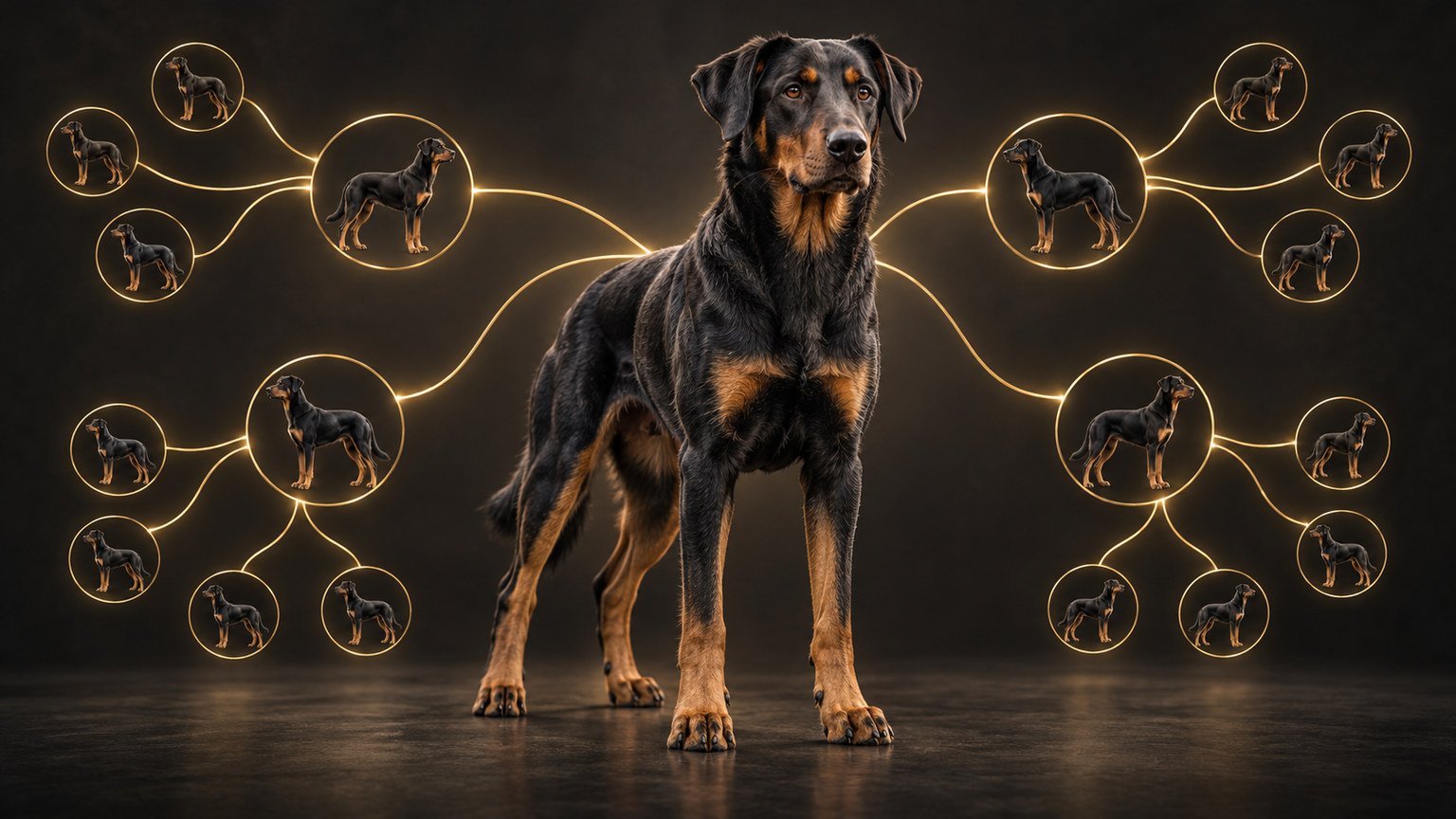
The popular sire effect happens when one male dog contributes disproportionately to a breed population because he, and sometimes his sons or other close relatives, are used much more often than other available sires. The dog may be healthy, successful and valuable to the breed. The population-level concern is not that he has good qualities, but that too much of the next generation can begin to trace back to the same genetic source.
This is best understood as a question of unequal genetic contribution. It is related to inbreeding and the coefficient of inbreeding (COI), but it is not the same as either one. A mating can have a relatively low pedigree COI while still adding to the long-term dominance of an already widespread sire line.
What is the popular sire effect?
A popular sire is a male used far more extensively than most other males in the same breeding population. There is no single universal puppy or litter threshold that makes a dog a popular sire. The significance of his contribution depends on the size and structure of the breed population, how many dogs are actually used for breeding, how many of his offspring reproduce, and whether his close relatives are also heavily represented.
The Royal Kennel Club’s genetic-diversity guidance explains that the number of times a sire can be used without creating a disproportionate contribution is breed-dependent. Counting his immediate puppies is useful, but following the breeding contribution of those descendants gives a more complete picture.
Why do some sires become so widely used?
Breeders usually choose a popular sire for understandable reasons. He may have excellent health results, a desirable temperament, strong working ability, successful offspring, a distinguished pedigree or notable show results. Frozen semen and international access can make one dog available to breeders far beyond his local population.
None of those qualities makes the dog genetically harmful. The popular sire effect describes what can happen when many breeders make the same reasonable individual choice and the combined result becomes a strongly unbalanced contribution at breed level.
How can one dog influence a breed population?
Every sire passes a sample of his DNA to each puppy. If he produces many offspring, more copies of the variants he carries enter the next generation. When numerous descendants are then selected for breeding, his contribution can spread through several branches of the pedigree and become difficult to avoid in later matings.
This process can shift allele frequencies: variants carried by the sire may become more common, while variants from males that were used little or not at all may become rarer or disappear from the active breeding population. That includes variants associated with desirable traits, neutral variants, and potentially harmful variants that were unknown or could not be tested at the time.
A pedigree analysis of ten UK dog breeds found highly unequal reproductive contributions and substantial losses of unique genetic variants across the generations studied. The exact pattern differed between breeds, which is why a raw puppy count should never be interpreted without population context.
Genetic diversity and unequal contribution
Genetic diversity is population-level variation. It is not simply a description of whether two dogs look different, come from different countries or appear unrelated in a short pedigree. A breed can have thousands of registered dogs while only a small proportion contributes to the next generation.
This is one reason geneticists distinguish census population size from effective population size. Effective population size is a theoretical measure related to how many individuals are effectively contributing genes and how evenly those contributions are distributed. It is generally smaller than a simple head count, especially where relatively few animals produce most of the offspring.
A 2025 analysis of 222 Royal Kennel Club breeds found substantial differences between breeds and concluded that population-management strategies must be tailored to each breed’s circumstances. That evidence argues against treating one fixed litter limit as universally safe or dangerous.
Why health testing does not remove every population-level risk
Health testing remains essential. DNA tests can identify particular known variants, while clinical screening can assess specific conditions or phenotypes. These results help breeders reduce defined risks and should be interpreted according to the relevant breed and testing programme.
However, a health-tested sire is not automatically risk-free from a genetic-diversity perspective. No testing programme examines every variant a dog carries, and some relevant variants have not yet been discovered or do not have a validated test. A dog that is clear for the conditions tested can still carry other recessive variants, as can every other dog.
The careful conclusion is not that health tests are inadequate. It is that individual health information and population-level genetic contribution answer different questions. Breeders need both perspectives. For more detail on test types and their limits, see Health Testing for Breeding Dogs and Clear, Carrier and Affected.
The popular sire effect and inbreeding are related—but not identical
Inbreeding concerns the mating of related individuals and the probability that an offspring inherits two copies of an allele from a shared ancestor. The popular sire effect concerns how unevenly one dog or lineage contributes to the population.
The two processes interact over time. Widespread use of one sire creates many descendants that share him as an ancestor. As those descendants and their relatives make up a larger share of the available breeding population, avoiding shared ancestry can become more difficult. Future matings may therefore have fewer genuinely distinct options, and average relatedness can rise.
That does not mean every offspring of a popular sire is highly inbred, nor that one use of a widely known sire automatically produces a high-COI litter. It means today’s unequal contribution can reshape the relationship structure from which later breeders must choose.
Where does COI fit?
COI is a measure calculated for a particular dog, pedigree or proposed mating, depending on the data and method used. It can help describe expected or realised homozygosity, but it does not by itself show whether a sire is becoming overrepresented throughout a breed.
A low COI for one planned litter can therefore be compatible with a longer-term increase in the use of the same sire line. Conversely, a population-management discussion cannot replace evaluation of the actual COI and health information for an individual mating. The separate guide What Is COI in Dogs? explains pedigree and genomic coefficients in more detail.
Pedigree information and genomic measures are not interchangeable
A pedigree records documented ancestry. Pedigree-based COI estimates the probability of inheriting alleles from common ancestors represented in that pedigree. Its interpretation depends on pedigree depth, completeness and the reference population.
Genomic measures examine DNA directly and can estimate realised homozygosity or aspects of genetic diversity that a short or incomplete pedigree may not capture. They are not simply a more detailed version of the same number. A multi-breed comparison of pedigree, SNP-chip and whole-genome measures showed that results vary with the method and pedigree depth used.
For practical breeder communication, it is important to state which measure is being discussed rather than treating pedigree COI, genomic inbreeding and population diversity as interchangeable labels.
What can happen over several generations?
- The sire’s contribution can multiply. His sons, daughters and later descendants may themselves become heavily used.
- Previously rare variants can become common. This includes beneficial, neutral and potentially harmful variants.
- Other lines may contribute less. Genetic variation not passed into the next generation cannot be recovered merely by choosing a different dog later from the same narrowed population.
- Shared ancestry can become harder to avoid. A sire may appear repeatedly through different pedigree branches.
- A close relative may continue the same concentration. Replacing an overrepresented sire with a son or another close relative does not necessarily create a meaningfully different genetic contribution.
A study of genetic-diversity trends across UK registered breeds linked unequal sire contributions with rates of inbreeding and effective population size. The important unit is therefore not just the famous dog, but his contribution in relation to the whole active breeding population.
Why small or closed populations may be more sensitive
In a numerically small breed, or in a subpopulation with few active breeding animals, a modest number of litters from one sire may represent a large share of the next generation. In a larger population, the same number may have a much smaller effect. Closed registries, past bottlenecks, strong subdivision between working and show populations, and restricted access to alternative lines can all change the context.
Imports are not automatically unrelated or genetically distinct. A foreign dog may already share widely used ancestors, and incomplete pedigree information can make relatedness appear lower than it is. The same popular sire effect can also occur around an imported dog if he is then used disproportionately.
What can breeders monitor?
- how many litters and puppies a sire has produced relative to the breed population;
- how many of his offspring and close relatives are also being used for breeding;
- repeated ancestors and concentrated sire lines across more than a short pedigree;
- pedigree COI, pedigree depth and any available genomic-diversity information;
- breed-level population reports, breed-club health programmes and diversity initiatives;
- health results, temperament, conformation and working information alongside—not instead of—population context.
This is a framework for asking better questions, not a mating prescription for an individual dog. The relevant evidence and trade-offs differ between breeds. When reading ancestry, the guide How to Read a Dog Pedigree can help distinguish documented names and repeated ancestors from conclusions the pedigree alone cannot support.
What the popular sire effect does not mean
- It does not mean a popular or champion dog is genetically “bad”.
- It does not mean every widely used sire spreads a known disease.
- It is not a problem limited to show breeding; unequal contribution can occur in any breeding population.
- It does not make health testing less important.
- It cannot be assessed from one universal litter limit without breed-population context.
- It does not prove that an apparently unrelated or imported dog will increase diversity.
Key takeaway
The popular sire effect is not a judgement about one successful dog. It is a population-level pattern created when genetic contribution becomes too concentrated. Responsible interpretation combines the qualities and health information of individual dogs with evidence about relatedness, representation and diversity across the breed.
Sources and further reading
- Royal Kennel Club — Manage and maintain genetic diversity
- Calboli et al. — Population Structure and Inbreeding From Pedigree Analysis of Purebred Dogs
- Lewis et al. — Trends in Genetic Diversity for All Kennel Club Registered Pedigree Dog Breeds
- Salt et al. — Modern Pedigree Dogs in the United Kingdom Kennel Club
- Dreger et al. — Whole-genome Sequence, SNP Chips and Pedigree Structure in Domestic Dog Breeds
Continue exploring breeder genetics and pedigree topics
Read What Is COI in Dogs? for a closer look at inbreeding coefficients, or explore Health Testing for Breeding Dogs for a practical overview of test types and responsible interpretation.