
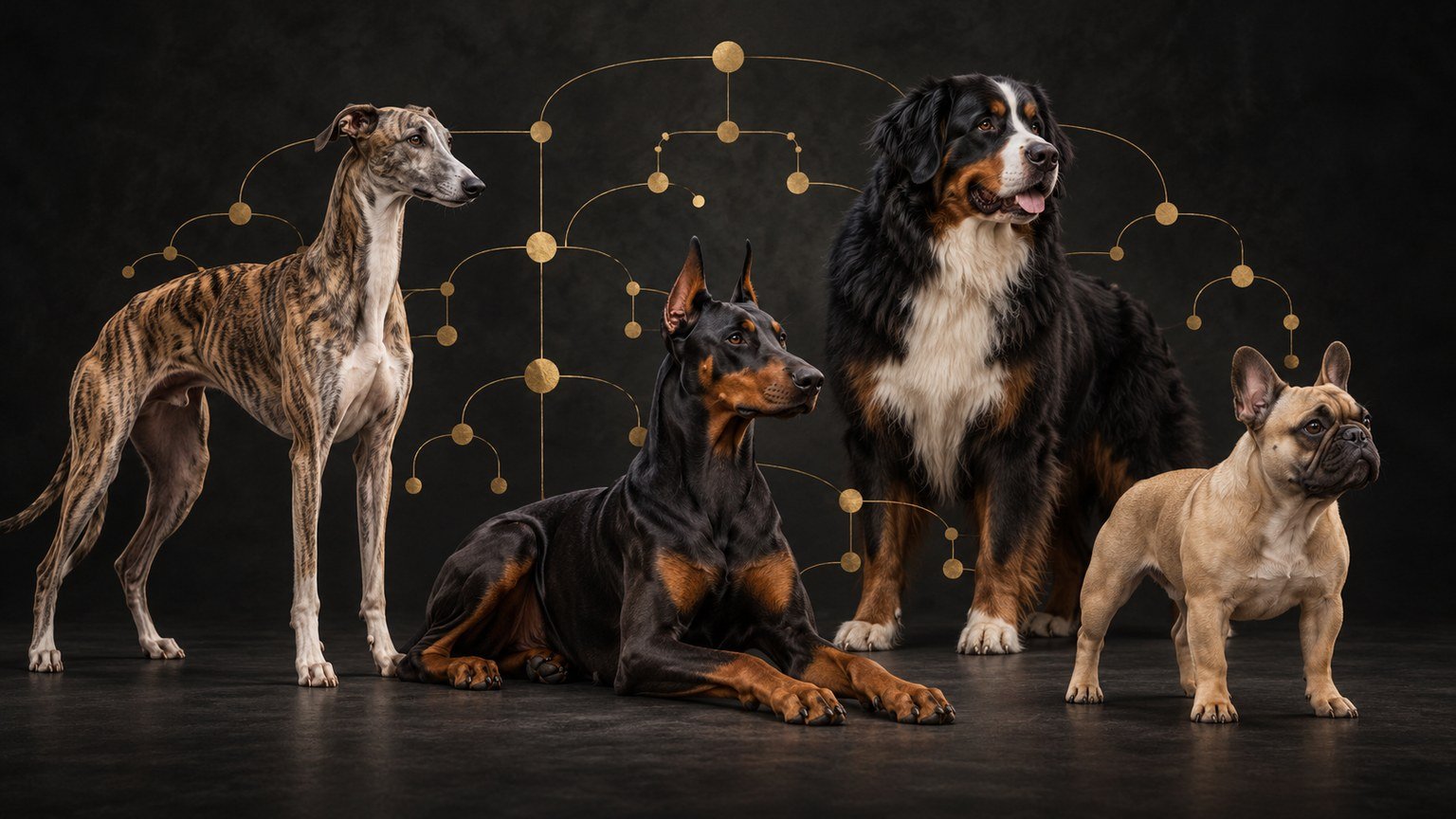
Genetic diversity in dog breeding is easy to reduce to a single number. A proposed litter has a coefficient of inbreeding, a DNA panel returns a set of results, and a pedigree shows familiar names. Each of those tools is useful, but none describes the whole genetic position of a dog, a breeding line or a breed population.
Responsible population management therefore asks a broader question: not only “How related are these two dogs?” but also “Which genetic options will remain available after this mating, and after the matings that follow it?” This guide explains why diversity matters beyond COI and how breeders can combine pedigrees, health testing, genomic information and population-level thinking without treating any single measurement as a guarantee.
Key takeaway: COI can estimate or measure homozygosity, but genetic diversity is a wider concept. It includes the variation carried by individual dogs, the differences among breeding lines and the distribution of genetic contributions across the whole breed.
1. What genetic diversity means in dog breeding
Genetic diversity is the variation in inherited material found within and among individuals in a population. In practical breeding, that variation includes common and rare alleles, different combinations of alleles, haplotypes inherited together and the degree to which dogs share long sections of DNA from common ancestors.
Diversity is not the same as visible variety. Two dogs can look different while sharing much of the same ancestry, and two dogs of a consistent breed type can still carry useful genetic differences. Nor does greater diversity mean that every dog should be bred. Health, temperament, function and breed-specific priorities remain important. The goal is to make selection without narrowing the population faster than necessary.
2. Diversity exists at three connected levels
The individual dog
At individual level, diversity is often described through heterozygosity and homozygosity. A dog that inherits identical copies of a genomic region from both parents has greater homozygosity in that region. Long runs of homozygosity can reflect recent shared ancestry, while shorter shared segments may represent older population history.
The breeding line
A line may preserve valuable traits, but repeated use of the same ancestors can also concentrate the same genetic material. A low-COI mating over a limited number of recorded generations may still join two dogs whose wider ancestry or genomic profiles are similar.
The breed population
At population level, what matters is how widely genetic contributions are distributed. A breed may have thousands of registered dogs but a much smaller number of animals contributing meaningfully to the next generation. If many litters descend from the same few dogs, census size can look reassuring while effective diversity continues to fall.
3. Why diversity matters for long-term breeding
When genetic variation is lost, future breeders have fewer combinations available. This can make it harder to respond to emerging disease risks, fertility concerns, changing environments or new information about inherited conditions. Reduced diversity also increases the chance that relatives carry the same recessive variants and that offspring inherit two copies.
That does not mean every highly homozygous dog will be unhealthy or every diverse dog will be healthy. Health is shaped by many genes, environment and chance. Population genetics describes changing probabilities, not individual destiny. The practical value of diversity is resilience: maintaining enough options for responsible selection over many generations.
A breeding decision can be successful in the next litter and still reduce choices for the breed ten years later. Good population stewardship considers both time frames.
4. What COI tells you — and what it does not
The coefficient of inbreeding estimates the probability that two copies of a gene are identical by descent from a shared ancestor. A pedigree COI is calculated from documented ancestry, so its usefulness depends on pedigree depth, completeness and accuracy. A genomic COI is based on DNA markers or runs of homozygosity and can reveal sharing that incomplete pedigrees miss.
COI is important because it helps compare proposed matings and track inbreeding over time. But one percentage cannot show which variants are being lost, how evenly founders are represented, whether a popular sire is reshaping the population or how different subpopulations relate to one another. For a fuller explanation of the calculation and its limits, see What Is COI in Dogs?
5. Pedigree diversity and genomic diversity are related, not interchangeable
Pedigrees describe expected inheritance. Full siblings have the same pedigree relationship, yet random recombination means they do not inherit identical segments from their parents. Genomic tools examine what was actually inherited at the markers measured. This can distinguish dogs that look equivalent on paper and can identify long homozygous regions.
Genomic results also have limits. Different laboratories use different marker sets, reference populations and algorithms, so scores are not always directly comparable. A result is most informative when the method is transparent, the breed reference group is appropriate and the breeder understands whether the report measures heterozygosity, genomic inbreeding, relatedness or another parameter.
The strongest approach uses both sources: pedigrees to understand documented ancestry and breeding history, and suitable DNA-based tools to investigate realised genomic sharing.
6. The popular sire effect can reduce diversity quietly
A successful sire may be healthy, titled and highly desirable. The population risk arises when his genetic contribution becomes disproportionate. Numerous descendants can spread his favourable traits, but they also spread variants that are unknown or cannot yet be tested. In later generations, finding mates unrelated to that sire becomes increasingly difficult.
This is why the effect is not solved simply by using a different son, grandson or close relative. Their pedigrees may appear under different kennel names while carrying much of the same contribution. Managing sire use means monitoring descendants and family representation, not judging the sire’s quality. Read the dedicated guide to the popular sire effect in dogs.
7. Effective population size matters more than headcount
Effective population size, often written as Ne, is the size of an idealised breeding population that would experience the same rate of genetic drift or inbreeding as the real population. It is usually smaller than the number of registered dogs. Unequal family sizes, an imbalanced number of breeding males and females, and repeated use of a few animals all reduce it.
A numerically popular breed can therefore have a constrained effective population, while a smaller breed with more balanced contributions may retain variation more effectively. Ne is a population-management measure, not a mating score. Breed clubs and researchers may estimate it from pedigree trends or genomic data to assess how quickly diversity is changing.
8. Founder effects, bottlenecks and closed populations
Every established breed begins with a finite founder population. Only part of the founders’ variation passes into later generations, and breed formation, wars, sudden changes in popularity or geographic isolation can create further bottlenecks. Closing a studbook preserves breed identity, but it also limits the arrival of new variants.
Genetic drift then changes variant frequencies by chance, especially in small populations. Rare variants may disappear even when breeders make careful individual choices. This historical background explains why two dogs with no recent common ancestor may still share substantial older ancestry. It also shows why managing only a five-generation pedigree cannot fully protect population diversity.
9. Linebreeding can preserve traits while narrowing options
Linebreeding is a form of inbreeding used to increase the influence of selected ancestors. It may make traits more predictable, but it also increases the probability that descendants inherit identical segments from those ancestors. Repeating the same lineage strategy across many kennels can narrow the wider breed even if each mating appears moderate in isolation.
The relevant question is not whether linebreeding is given a reassuring label, but how much shared ancestry it creates, which families are already overrepresented and what alternatives remain. See Linebreeding in Dogs vs Inbreeding for a closer comparison.
10. Health testing should guide selection, not empty the gene pool
Health testing is essential when validated, breed-relevant tests and screening schemes are available. However, a DNA result for one condition is not a complete assessment of a dog’s genetic value. Automatically removing every carrier of a recessive variant can discard healthy dogs and useful diversity, especially in a small population.
For many autosomal recessive conditions, a tested carrier can be mated to a clear dog without producing affected puppies, provided offspring are tested and future matings are managed. The exact decision depends on the condition, test validity, inheritance, prevalence and official breed guidance. The guides to clear, carrier and affected results and health testing for breeding dogs explain this in more detail.
11. How diversity is lost across generations
- Many litters are produced by a small number of fashionable sires or families.
- Breeding stock is excluded for every detectable variant without considering safe carrier management.
- Breeders repeatedly select within a show, working or geographic subpopulation and assume other groups are genetically equivalent.
- Imported dogs are treated as automatic outcrosses even when the same ancestors dominate internationally.
- Only short pedigrees are reviewed, hiding repeated ancestors further back.
- Selection becomes so narrow that few dogs meet every preferred trait, title and test criterion.
None of these choices is necessarily harmful once. The cumulative pattern is what matters. Diversity is usually lost gradually, then becomes obvious only when unrelated options are scarce.
12. Tools breeders can use
Start with the best records available: complete pedigrees, verified parentage where relevant, health results, litter data, longevity, fertility, temperament and causes of death. Breed databases can help identify repeated ancestors and estimate pedigree COI, but their coverage and calculation depth should be checked.
Genomic relatedness, heterozygosity and runs-of-homozygosity reports may add useful information when the service has adequate breed data and clear methodology. Breed-club population reports can reveal trends that no individual breeder can see. The value lies in interpreting these tools together, not ranking dogs by a single score.
13. Outcrossing is a strategy, not a universal shortcut
Within a breed, an outcross often means pairing dogs from less-related lines. In a formal conservation programme, it may also mean introducing dogs from another population or breed under carefully defined rules. These are different interventions and should not be confused.
An outcross can reduce inbreeding and introduce useful variation, but it requires clear objectives, reliable health and pedigree information, plans for evaluating several generations, and cooperation with breed organisations where registration rules apply. It can also introduce unwanted variants or traits. “Unrelated” on paper is not proof of genomic difference, and one imported dog used excessively can become the next popular sire.
14. A practical diversity checklist for a proposed mating
Before deciding, ask:
- How complete is the pedigree, and how many generations does the COI calculation include?
- How does the proposed litter compare with the breed’s current and historic average inbreeding?
- Which ancestors and families are repeated, and how common are they in the wider population?
- Has either dog or close relatives already contributed many offspring?
- Do genomic tools add information that the pedigree cannot provide?
- Are health tests interpreted condition by condition rather than as a simplistic clear-only rule?
- What information exists on fertility, longevity, temperament and health across the family?
- Will the mating preserve future choices, or make the next generation harder to match responsibly?
15. Think in generations, not only litters
A breeder controls only part of a population, but each litter changes the options available to others. Coordinating across kennels can spread genetic contributions more evenly, retain underrepresented families and reduce repeated dependence on the same successful dogs. Sharing accurate data — including ordinary outcomes, not only exceptional ones — improves those decisions.
Long-term planning also means avoiding rigid thresholds without context. A lower COI is generally preferable when other priorities are comparable, but the lowest number is not automatically the best mating. A balanced decision considers health, temperament, function, conformation, relatedness, family history and the needs of the wider breed.
Final takeaway: Genetic diversity is not a competitor to responsible selection; it is part of responsible selection. COI, pedigrees, DNA tests and genomic tools each reveal a different part of the picture. Used together — and interpreted at individual, line and population level — they help breeders protect both the quality of the next litter and the choices available to future generations.
Sources & further reading
- Fédération Cynologique Internationale: International Breeding Strategies
- The Royal Kennel Club: Health screening for dog breeders
- Wade CM. Inbreeding and genetic diversity in dogs: results from DNA analysis
- Calboli et al. Population structure and inbreeding from pedigree analysis of purebred dogs
- Jansson & Laikre. Pedigree data indicate rapid inbreeding and loss of genetic diversity
- Hayward et al. Whole-genome sequence, SNP chips and pedigree structure in domestic dog breeds
- Marsden et al. Bottlenecks and selective sweeps during domestication