
Health test results on a dog breeder website should be easy to find, specific enough to understand and connected to the correct dog. The goal is not to fill a profile with the greatest possible number of abbreviations. It is to show what was tested, the result, who issued or recorded it, when it was completed and—where a suitable public record exists—how another breeder or puppy buyer can verify it.
Key principle
Show the result clearly enough that another breeder or puppy buyer can understand what was actually tested. A precise summary is more useful than a long list of unexplained codes or a generic claim that a dog is “health tested”.
This guide focuses on communication and information architecture. It does not replace breed-specific testing guidance, veterinary advice or the interpretation supplied by the testing organisation. If you first need an overview of test types and breeding considerations, read Health Testing for Breeding Dogs.
1. Make health results easy to find
The main health information for a breeding dog should not be hidden in an About page, an old blog post, a photo caption or a folder of unnamed PDFs. The most useful primary location is the individual dog profile. Visitors can then connect each result with the correct registered dog rather than trying to work out which certificate belongs to which animal.
A breed or health overview page can explain the kennel’s wider testing approach, the schemes commonly used and why particular tests matter. It should support—not replace—the dog-level record. A clear site architecture also makes health information easier to maintain and discover; this is one of the practical questions covered in What Should a Dog Breeder Website Include?.
2. Give every breeding dog a structured profile
A useful dog profile separates different information types instead of placing everything in one long paragraph. Registered identity, pedigree, health screening, DNA results, show or working achievements and breeding information answer different questions and deserve distinct labels.
- Identity: registered name, date of birth and registration number where appropriate to publish.
- Pedigree: an on-page pedigree or a clear link to the dog’s pedigree information.
- Health: named examinations, DNA tests, results, dates and verification options.
- Achievements: titles and results kept separate from medical or genetic information.
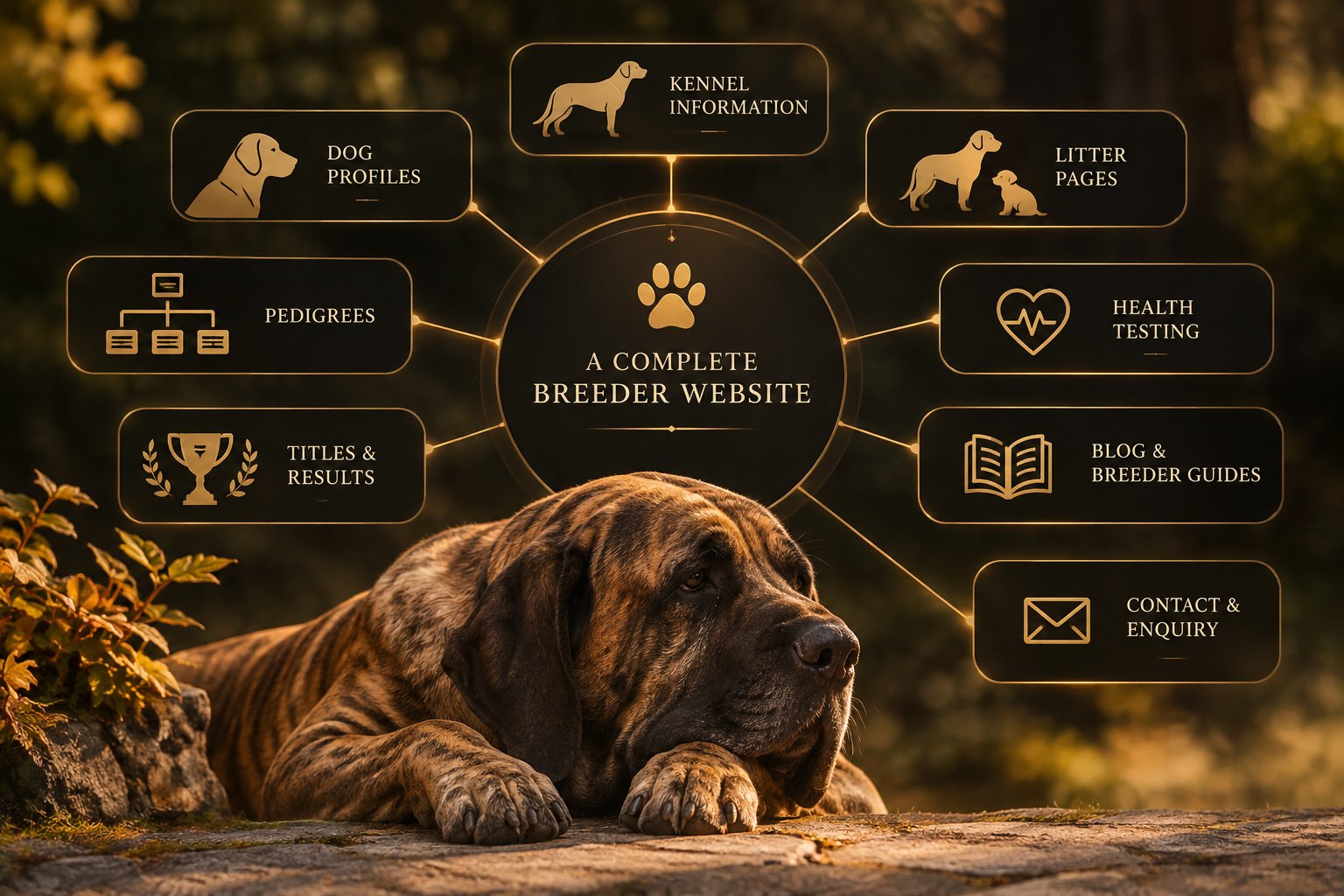
This separation matters. A pedigree relationship is not a test result, and a show title does not validate a health examination. If a profile also explains ancestry, link to a fuller guide such as How to Read a Dog Pedigree rather than trying to teach every topic inside one page.
3. Write the full test name before using an abbreviation
Experienced breeders may recognise “HD”, “ED” or “DM” immediately. Many puppy buyers will not, and the same shorthand may be used differently across countries or organisations. On first mention, write a clear name such as “hip dysplasia evaluation”, “elbow dysplasia evaluation” or “degenerative myelopathy DNA test”, followed by the abbreviation if it will be used again.
Do not translate one scoring system into another unless an authoritative source explicitly supports that equivalence. An FCI hip grade, a BVA/Kennel Club score and an OFA evaluation come from different systems. Preserve the original result and name the issuing scheme.
4. Separate screening results from DNA tests
Clinical, imaging or specialist screening
Hip and elbow evaluations, eye examinations and cardiac examinations describe findings from a particular assessment method at a particular time or age. Depending on the scheme, the record may contain a grade, score, classification or descriptive outcome. Display that outcome using the scheme’s own terminology.
DNA or genetic testing
A DNA test usually addresses a defined variant or condition. Where the laboratory reports clear, carrier or affected status, reproduce the actual result and identify the condition. “Clear” for one tested variant does not mean the dog is free from every inherited disease. For a careful explanation of these terms, link to Clear, Carrier and Affected.
Do not merge unlike results into one “health clear” label. A radiographic grade, an eye examination and a DNA status describe different evidence and should remain distinguishable on the page.
5. State the result—not merely that testing happened
“DM tested”, “eyes checked” and “DNA okay” tell the reader that something may have happened, but not what was found. A useful entry identifies the test and records the result exactly as supported by the report. Avoid vague expressions such as “healthy”, “all clear” or “fully tested” in place of evidence.
If an outcome is pending, preliminary, inconclusive or subject to confirmation, say so plainly. Do not turn an incomplete result into a positive claim. When the final result arrives, update the profile rather than leaving two conflicting versions online.
6. Name the laboratory, scheme or registry where useful
The organisation behind a result gives the reader context. It might be a national kennel club scheme, a breed-specific health programme, a recognised laboratory, the Orthopedic Foundation for Animals (OFA) or another registry relevant to the dog’s country and breed.
Do not imply that one organisation is the only credible route worldwide. Registries, accepted laboratories and reporting formats vary. Use the name shown on the report, and add a public record link when that organisation provides one.
7. Include dates when they add meaning
Dates help distinguish a recent examination from an older record and show when an age-dependent assessment was performed. They are particularly useful for eye, cardiac or other examinations that may be repeated under a breed or scheme’s guidance. Do not publish a universal retesting interval: follow the relevant scheme, veterinary guidance and breed recommendations.
A DNA result for a defined inherited variant is different from a periodic clinical examination. The page can still show the test date for traceability, but it should not present every result as if it expires in the same way.
8. Offer verification where it is genuinely available
A direct registry record can make a result easier to verify. OFA, for example, maintains searchable animal records covering radiological, physical-examination, laboratory and DNA results. Other countries and schemes use different public databases, certificates or publication rules.
Link to the individual animal record rather than a generic registry homepage when a stable public URL is available. Check the link periodically. If the record is not public, do not imply that its absence proves the dog was never tested; disclosure rules and database coverage differ.
9. Choose the right mix of text, certificates and registry links
- Structured webpage text is fastest to scan and works best for the essential summary.
- A registry link offers independent verification when a suitable public record exists.
- A certificate or PDF can provide detail that does not fit comfortably in the profile.
In many cases, the strongest presentation combines a concise on-page summary with an optional verification route. A certificate image alone is rarely enough: text may be tiny on mobile, inaccessible to screen readers and difficult to search. Publishing every document is not automatically required, especially where privacy, ownership information or registry rules need consideration.
10. Explain results without turning the profile into a textbook
A puppy buyer may not know what PRA, DM, N/N, carrier or an eye examination outcome means. Add a short plain-English explanation beside the result or link to a reliable glossary or educational article. Keep it specific: explain what that result says and what it does not say.
A tooltip, short note or expandable explanation can reduce visual clutter, but the core result should remain visible without interaction. Do not hide the only meaningful information behind an icon.
11. Present carrier status accurately and openly
Carrier is not a synonym for clinically affected, and it is not irrelevant. For a recessive condition, the result can matter to breeding decisions even when the dog is unlikely to develop that condition because of carrier status alone. The website should show the reported status without turning it into either a stigma or a guarantee.
Do not hide a carrier result among dozens of panel items or replace it with “DNA tested”. If the kennel explains mating decisions, keep the wording factual and condition-specific rather than giving universal breeding instructions.
12. Be cautious with “fully health tested”
“Fully health tested” sounds reassuring but is incomplete without context. Breed recommendations differ, health schemes change, new tests appear and not every risk has a screening test. A CHIC number in the OFA system, for example, indicates that the tests required by the participating parent club were completed and made public; it does not by itself mean every result was normal.
Replace the broad claim with a named list of tests and results. Readers can then assess the evidence against current recommendations for that breed and region.
13. Keep testing breed- and programme-specific
There is no responsible universal checklist for every breeding dog. Relevant tests may depend on the breed, known disease prevalence, national kennel club, breed club, lineage and the breeder’s programme. The Royal Kennel Club Health Standard and OFA’s breed-specific CHIC protocols illustrate how recommendations can be organised around particular breeds and updated as priorities change.
Use the website to show why the displayed information belongs to this dog and breed. Do not copy another kennel’s test list simply because its profile looks comprehensive.
14. Use a simple, repeatable health-results structure
A compact table can work well when every dog uses the same column order. The following is a presentation template, not a set of real results:
| Test or examination | Result | Date | Verification |
|---|---|---|---|
| Hip evaluation | [Result exactly as issued] | [Year or date] | [Registry or certificate] |
| Eye examination | [Recorded finding] | [Examination date] | [Certificate, if available] |
| [Named] DNA test | [Clear / carrier / affected, as reported] | [Test date] | [Laboratory or registry] |
If a result needs explanation, place a short note directly below the table. Keep the same layout across dog profiles so visitors do not have to relearn the page for every dog.
15. Give long genetic panels a clear hierarchy
A panel containing dozens of variants does not need to give every line equal visual weight. Put breed-relevant tests and actionable statuses first. Additional panel results can sit in a secondary table, an expandable section or the full laboratory report.
Do not describe a large panel as proof that the dog is “genetically healthy”. A panel only addresses the variants included and the limits stated by the laboratory.
16. Design the health section for mobile readers
Health information must remain usable on a phone. Prefer four concise columns or fewer, allow a table to scroll horizontally inside its own container when necessary, and keep explanatory text at a readable size. Avoid eight- or ten-column layouts, tiny certificate thumbnails and abbreviations that require constant zooming.
The surrounding dog profile should use real headings and structured text rather than a single flattened graphic. That helps accessibility and supports the same crawlable content principles discussed in Dog Breeder Website SEO.
17. Update profiles when the evidence changes
Update the dog profile when a new test is completed, a result arrives, a periodic examination is repeated or a registry link changes. Remove outdated “pending” labels and fix broken certificate links. A visible “last updated” note can be useful on complex records, but it does not replace keeping the individual entries accurate.
18. Keep litter pages concise and connected
A litter page does not need to reproduce every certificate and panel entry for both parents. Show the sire and dam, provide a concise health summary and link to each parent’s current profile. This reduces duplicated information and gives the kennel one primary place to maintain each dog’s record.
19. Avoid common presentation mistakes
- Abbreviations without full test names or scheme context.
- “Tested” without the actual result.
- Outdated examinations, pending labels or broken registry links.
- Certificates shown only as tiny, unreadable screenshots.
- Health results mixed into show titles and promotional copy.
- A generic “healthy parents” statement with no supporting detail.
- Different labels and formats for every dog.
20. Use a practical health-results checklist
Essential
- The correct dog identity.
- The full test or examination name.
- The actual result, using the issuing organisation’s terminology.
- Consistent, readable formatting.
Strongly useful
- Date or year where it adds context.
- Laboratory, scheme or registry.
- Verification link and a short plain-English explanation.
When relevant
- Certificate or detailed report.
- Registry number, repeat-examination date or extended panel section.
Final takeaway
Health transparency is not about showing the largest number of tests. It is about presenting the right information accurately and making each result understandable and verifiable. A strong breeder website respects the difference between pedigree, clinical screening, DNA status and breeding information—and gives each one a clear place.
Need a breeder website that presents health information clearly?
BodArtDogs creates custom WordPress websites for breeders and kennels, with dog profiles and content structures designed around real breeding information—including pedigrees, health testing and breeding results.
Sources & Further Reading
- Orthopedic Foundation for Animals: Getting Started at OFA
- Orthopedic Foundation for Animals: Canine Health Information Center (CHIC)
- Orthopedic Foundation for Animals: Policies and Public Access
- The Royal Kennel Club: Health Standard
- Fédération Cynologique Internationale: Hip Dysplasia Classification